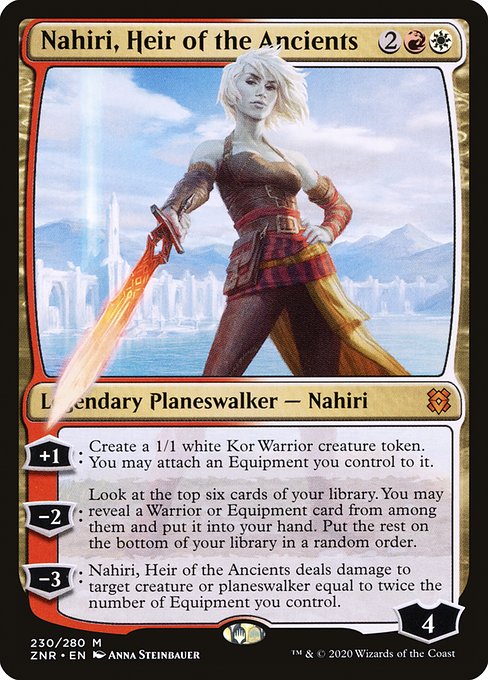
Image courtesy of Scryfall.com
Nahiri, Heir of the Ancients: A Balance of Market Demand and Playability
In the realm of MTG, some cards become cultural touchstones not just because they win games, but because they spark conversations about design, value, and playstyle. Nahiri, Heir of the Ancients — a Legendary Planeswalker from Zendikar Rising — sits squarely at that crossroads 🧙🔥. With a mana cost of {2}{R}{W}, she arrives as a red-white beacon of offensive tempo and equipment-driven support, a combination that resonates with both deckbuilders chasing new ideas and collectors chasing a striking mythic in a beloved multiverse. The card’s rarity and art by Anna Steinbauer lift it from “just another walker” to a centerpiece for discussions about market demand versus practical playability 💎⚔️.
Released during the Zendikar Rising era (znr set), Nahiri is a steadfast reminder that market demand often tracks not only power, but also the narrative of a color pair and a broader deck-building philosophy. Red and white together have historically leaned into fast, punchy strategies and flashy if sometimes fragile combos. Nahiri leans into that DNA, offering a toolkit that rewards proactive board development and thoughtful weapon-wielding. The crimson spark of mana cost meets a loyalty dial that starts at 4, inviting a rhythm of growth and disruption that can outpace slower opponents and outvalue solitaire engine turns in Commander tables 🧭🎲.
What makes Nahiri tick on the battlefield?
- +1 loyalty ability: Create a 1/1 white Kor Warrior creature token. You may attach an Equipment you control to it. This is more than a token generator; it’s a doorway to Equipment-centric plays. The Kor Warrior’s combat presence can be leveraged as a flexible platform for weapons, adding a nimble frontline that can become a moving target for both aggression and protection 🗡️⚔️.
- -2 loyalty ability: Look at the top six cards of your library. You may reveal a Warrior or Equipment card from among them and put it into your hand. Put the rest on the bottom of your library in a random order. This is a powerful tutor-like tempo piece that shores up card quality, enabling you to accelerate into key threats or combos—especially in builds that care about Equipment count or Warrior synergy. The “top six” window creates a predictive, strategic layer that players love to theorycraft around 🧠🎯.
- -3 loyalty ability: Nahiri deals damage to target creature or planeswalker equal to twice the number of Equipment you control. This punch scales with your Equipment density, turning a modest board into a potential finishing stroke. It’s a built-in removal finisher for the right board state and can catch opponents unprepared when you’ve stacked a few gear-backed threats across the battlefield ⚔️💥.
In practical terms, Nahiri shines in decks that lean into Equipment and artifacts, especially in Commander where long games and stacked combos are the norm. The top-six tutor plus the built-in damage burn synergy provides both inevitability and flexibility. It’s a card that rewards planning: you’re not just playing to beat down, you’re sculpting a gear-laden engine while keeping an eye on the damage ceiling you can push with every swing of a weapon-wielding token. The ability to attach an Equipment to your own token also hints at a modular playstyle—one that can adapt to opposing boards and resilience against mass removal 🃏.
Why market demand loves Nahiri, but playability keeps it grounded
Market demand for Nahiri, Heir of the Ancients is buoyed by several factors. First, the card’s mythic rarity and bold, fiery aesthetic make it a favorite for collectors who chase standout cards from Zendikar Rising. The foil version, while pricier, tends to be a draw for players seeking a showpiece in their commander decks. The card’s price points—roughly around USD 0.67 for non-foil and USD 0.89 for foil in the current market snapshot—signal a low-to-mid investment with potential for future growth in rotating formats or EDH trends. It’s not a gatekeeper of formats; instead, it’s a value proposition for players who want a resilient, multi-format walker that scales with their build 🧭💎.
From a design perspective, Nahiri embodies a thoughtful balance: a mana cost that fits into midrange and control shells, a +1 that creates a tempo engine, a -2 that shores up card quality (especially for Warrior- or Equipment-centric stacks), and a -3 that rewards players for developing a robust Equipment count. That combination, in turn, feeds demand because it provides both aggressive and strategic options. The card’s relevance spans Modern, Pioneer, Commander, and even Eternal formats that love the interplay between artifacts, weapons, and big-name planeswalkers. The presence of a known synergy set—the “A-Nahiri, Heir of the Ancients” combo piece and the token Kor Warrior—also gives deckbuilders a ready-made puzzle to solve, which is a magnet for article writers, content creators, and meta-chasers alike ⚔️🎨.
Deck-building sparks: practical ideas you can try
- Equipment-forward RW: Lean into swords, lances, and a stabilizing suite of protection auras and pump spells. Nahiri’s -3 scales with Equipment, so a few heavy hitters in play can turn a simple board into a blazing finisher. Include classic staples like Lightning Greaves, Sword of Fire and Ice, and Bonesplitter for reliable buffs and card draw help. The token from +1 can be a mobile platform for projectile pressure, especially when you have the right removals and recursions lined up 🧙🔥.
- Warrior or Equipment package: Build around the top-six tutor ability by ensuring you want either a Warrior or Equipment frequently. This encourages a targeted draw that smooths your turns and reduces the risk of whiffing on critical pieces. In this mode, you’ll be courting synergy with other cards that care about Warriors or with artifacts that turn on more damage, more tokens, and more value 🎯.
- Hybrid control-aggro approach: Nahiri’s versatility lets you pivot between tempo plays and a more controlling arc when the board state demands it. A lean removal suite, plus a handful of evasive threats, can turn Nahiri into the engine that drives late-game stalls and explosive finishes. It’s the kind of deck that feels as satisfying to pilot as it is to watch your opponents react to the tempo swing 🧠⚡.
“Market demand often latches onto the story and the community around a card—Nahiri’s blend of flame and forge has that story, and the play pattern delivers the spicy midgame twists fans crave.”
Collectors and players alike appreciate the card’s narrative aura—the idea of Nahiri, the Lithomancer, melding weapons and will into a force that can reshape a table. In a world where the price of a single card can swing on a rumor or a new synergy, Nahiri remains a reliable centerpiece for RW Equipment shells and for fans who love the lore-driven facets of the multiverse 🧙🔥.
For those who enjoy a bit of cross-promotion in their MTG journey, this card pairs nicely with the broader culture of collecting and gaming gear. If you’re chasing a tactile, collectible piece to compliment your battle-ready toolbox, you might also consider upgrading your gears with modern accessories—perfect for transporting your decks to local tournaments or casual gatherings—and yes, you might even find a deal that makes your wallet as comfortable as your throne on the battlefield 🎲.
As the multiverse continues to expand, Nahiri’s presence in Zendikar Rising remains a testament to how a single planeswalker can influence both playstyle and market dynamics. The card’s accessible mana cost, coupled with a robust suite of abilities, makes it a compelling choice for players building around Equipment- and Warrior-centric strategies, while its mythic status keeps it in the conversation for collectors seeking rarity and impact.