Image courtesy of Scryfall.com
Orcish warfare and the lore that binds a red-hot army
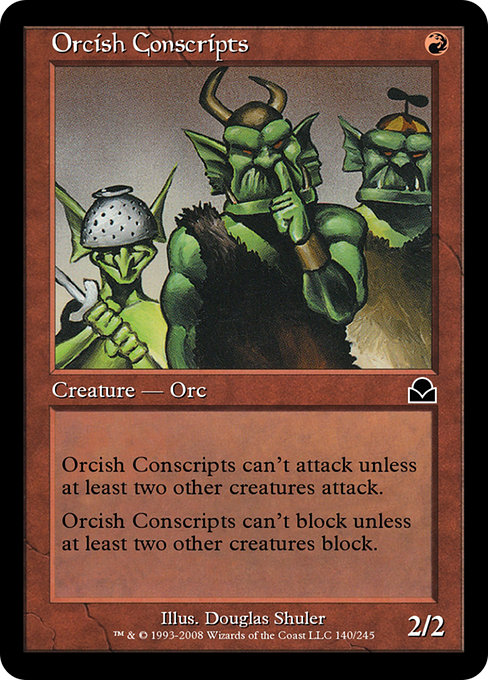
If you’ve ever cracked open a dusty old Dominaria guide or rewatched the Clash of Warbands across MTG’s history, you’ve felt the same spark that animates a simple red drop facing down a sea of bodies: raw momentum. The piece at the heart of this discussion is a modest one-mana creature with a big reputation in how it frames orcish combat. A 1-drop red creature that’s a sturdy 2/2, yet carries a paradoxical restriction—this creature can’t attack unless at least two other creatures attack, and it can’t block unless at least two other creatures block. It’s a hinge card, a reminder that in orc culture, brute force tends to travel in packs. 🧙🔥
From battlefield dynamics to battlefield myth
In the lore of MTG, orcs are often depicted as the ironclad backbone of raiding parties and warbands, renowned for their fierce loyalty and ruthless efficiency. A single warrior might be formidable, but the hallmark of an orkish assault is coordination—three bodies driving a breach where one would fail. The card’s rules text mirrors that aesthetic: a veteran’s insistence that victory isn’t a one-on-one slugfest but a synchronized charge. The flavor is not about individual bravado but about the collective rattle of drums, the chorus of axes, and a brutal discipline that makes the whole greater than its parts. This is red mana as theater—hemorrhaging boldness, but with a strategic spine. ⚔️
“Warbands are not merely decks of cards; they are stories you tell with every attack and every block.”
That sentiment threads through MTG’s broader lore: orc tribes are often depicted as close-knit communities where leadership emerges from proven results in the field, where a grunt’s path to glory runs through the success of a larger plan. The Me2 printing—Masters Edition II—reintroduced this archetype to new players while preserving the timeless rhythm of orcish aggression. The collectible’s common rarity underscores a different kind of value: accessibility and historical flavor rather than chase-worthy foil prices. And yet, those who collect or play legacy formats know that a single such card can be the glue in a veteran red shell, a reminder of how a warband can seize the initiative when it matters most. 🎨
Flavor, art, and the quiet menace of a low-cost creature
Douglas Shuler’s illustrated touch on this card—an evocative, gritty orc gazing forward with a collision of pride and pragmatism—embodies the era’s aesthetic: clear lines, bold color, and a sense that every piece of armor is earned through skirmishes that fans still narrate around kitchen tables and tournament floors. The art’s confidence complements the mechanic’s restraint: you’re not overpaying for a cackling hero, you’re investing in a team that’s dangerous only when the rest of the squad is aligned. The flavor of orcish warfare—packs marching as one, the alarm of horns, and the inevitability of a surround attack—comes to life in the card’s margins, where the ultimate impact is not a solo legend but a well-coordinated assault. 🧙♂️💎
Practical play: building around the two-attack/discipline motif
In modern casual and legacy play, you’ll find this creature most compelling in decks that maximize aggro while embracing mass participation in combat. Here are a few principles and tips to weave into a board of red might:
- Token amplification: Pairing with tokens or other low-cost attackers makes the two-offense requirement more accessible. Cards that generate multiple bodies per turn or that reward multi-block scenarios can unlock the card’s full potential.
- Combat tricks and encore effects: Spells that empower creatures or bend blocking rules can help keep your board pressure consistent. Think pump spells, or temporary exile-and-return stunts that keep the tempo favorable.
- Pairing with synergy targets: Creatures that benefit from “attack with multiple creatures” tactics—either by increasing power on the board or by offering a strategic edge when foes overcommit—can turn a humble 2/2 into a driving force for victory.
- Format considerations: In Legacy, the card sits comfortably as a common, with legal status, and in Pauper-legal circles it remains a familiar presence. It’s not typically the star of the show, but it acts as a reliable backbone in red-led archetypes that want tempo, resilience, and a bit of chaotic edge. 🎲
Orcs across planes: a cultural throughline
What makes the trope so persistent? Orcs in MTG frequently embody the pressure of communal warfare: a culture that values strength in numbers, improvisation on the battlefield, and the stubbornness to press an advantage until it’s decisively won. Across Dominaria’s storied history and into newer planes, these warbands echo this same ethos—hordes that unleash coordinated charges, rely on the synergy of the front line, and respect the brutal math of a well-tought-out march. This is why a seemingly simple card—just one mana, two power, a couple of thresholds—echoes so much narrative energy. It’s the flavor of a story you’ve seen before and can see again, with the same drumbeat under a different sky. 🧭
Collecting, value, and a nod to the old school
From a collector’s lens, this common stands as a testament to the enduring charm of Masters Edition II—the set that sought to reintroduce classic staples with a modern print quality. The art and text remain faithful to early MTG’s identity, giving us a window into a time when red was a relentless, practical force rather than a flashy finale. In terms of price, the card’s current market sits modestly on the scale—perfect for a nostalgic binder and a few playful kitchen-table matches with friends who learned the game in its earlier days. If you’re a lore-driven player who loves the sense of history that a single card can carry, you’ll appreciate how the two-attack rule recasts the battlefield as a narrative canvas. ⚔️
Blending lore, gameplay, and a little cross-promotion
For fans who want a tactile reminder of the MTG multiverse’s enduring warmth, consider adding a touch of real-world flair to your desk setup with a premium mouse pad. The Neon Rectangle Mouse Pad Ultra-thin 1.58mm Rubber Base is a charming companion for long nights of deck-building and lore-reading—perfect for a table where you hatch plans for red burn and black rivulets of mana. This little intersection of game culture and everyday utility is a subtle nod to how the MTG community blends collectability, practical play, and personal style. ✨ 🧙🔥
In the end, the relationship between a red creature and its surrounding board is a reminder that MTG’s magic lies not only in flashy finishes but in the quiet arithmetic of commitments. When three or more teammates storm forward, the battlefield becomes a story with a clear climax: momentum, cooperation, and the thrill of an inevitable turn that changes the game’s course. The older ME2 printing carries that memory forward, inviting both veterans and newcomers to consider how a simple 1-drop can symbolize a timeless principle in the lore: unity makes strength.