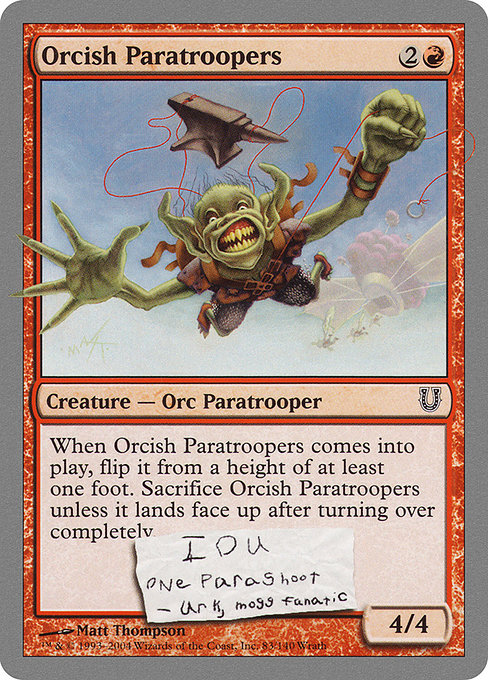
Image courtesy of Scryfall.com
Orcish Paratroopers MTG Art: Traditional vs Digital
If you’ve ever swapped brushes for a Wacom tablet and felt the room tilt between the tactile thrill of a pencil line and the bright neon punch of a digital palette, you’re not alone. MTG art has long walked that line between traditional and digital methods, and the Unhinged set is a delightful case study in how those worlds collided with humor and bravado. The illustration for Orcish Paratroopers—done by Matt Thompson and rendered with the kind of kinetic energy that makes you lean forward in your chair—offers a playful lens on how artists approached card art in the early 2000s, especially within a set built on whimsy and satire. 🧙♂️🔥💎
Orcish Paratroopers is a red creature—mana cost {2}{R}—that clocks in at a sturdy 4/4. Its flavor and mechanics are as cheeky as the set name itself: when the creature enters the battlefield, you flip it from a height of at least one foot; if it doesn’t flip and land face up, you sacrifice it. It’s not just a creature; it’s a miniature performance piece on a card. In the Unhinged world, the art had to communicate that motion and risk in a single frame, and Thompson’s render does that with swagger. The piece lives at a moment where a paratrooper’s dive becomes a dramatic, almost comic, action sequence—bright colors, bold lines, and a dash of chaos that the set invited. ⚔️🎨
What the card teaches about traditional vs digital illustration
In 2004, MTG art lived in a transitional space. Traditional media—pencils, inks, acrylics—provided a tactile texture that many players still crave: grainy textures in the shadows, the subtle pencil marks, the warmth of a hand-painted gradient. Digital tools were rising but not yet the default for every major card; artists often started with traditional studies and used digital embellishments to punch up color, contrast, and iteration speed. Orcish Paratroopers sits at that crossroads: a highres image scan from the original painting ensures that the crispness you see in modern digital pieces is there, while the humor and spontaneity in the pose hint at the spontaneity that digital workflows later amplified. The art’s bold red palette plays into rapid, kinetic energy that feels instantly legible at the table. 🧙♂️🔥
- textured brushwork, organic line variation, a sense of “handmade” charm that many players associate with classic MTG aesthetics.
- Digital strengths: scalable contrast, easy experimentation with lighting and color, precise edges for card printing, and the ability to push a wry, cartoonish moment to the foreground without losing readability at common play sizes.
Unhinged as a set is a playful showcase for these ideas. The silver border and the funny set type signal a different kind of artistry—one that aims to provoke a smile even before the effect text is read. The Orcish Paratroopers card captures that ethos: a red creature whose enter-the-battlefield action invites interaction, risk, and a little theatrical mischief. The piece leans into comic timing, and you can almost hear the narrator whisper, “Flip it, flip it good!” 🧲⚡
Flavor, mechanics, and art synergy
IOU one parashoot — Urk, mogg fanatic
Flavor text aside, the art and the flip mechanic work in concert to tell a story: a fearless orc executing a risky, high-velocity entry, with the potential to flip completely and land squarely on the battlefield. The requirement to flip at least once during the descent is a playful nod to the unpredictable nature of the humor in Unhinged and to the era’s experimental card design. The illustration communicates both aggression and whimsy, a synergy that made the card memorable long after the draft. The red mana emphasis—paired with a 4/4 body—signals raw power, while the image suggests a moment of potential calamity that keeps opponents guessing. This is the kind of art that invites not just strategic appreciation but storytelling at the table. 🧙♂️⚔️
Collector value, rarity, and market warmth
In the broader MTG landscape, Orcish Paratroopers is a common rarity in Unhinged, with both foil and nonfoil finishes available. That combination often yields a price profile that’s accessible to casual collectors while still offering a foil option for those who prize displayable rarity. The data from Scryfall indicates modest current values—roughly a few dimes for nonfoil and a bit more for foil in the modern market—reflecting its status as a beloved yet approachable funny card. The Unhinged print, with its funny set branding, often carries sentimental value for players who remember the era when card art leaned into caricature and spectacle. 💎🎲
For players who enjoy building themed decks around unusual interactions, Orcish Paratroopers stands out as a talking point: a card that is playable in casual formats and shines in decks that celebrate odd flips, misdirects, or pure theatrical value. The card’s flip mechanic is a reminder that MTG remains as much a story engine as a game engine, where the art, lore, and rules can spark an entire memory bank of table-side banter. In print form, both foil and nonfoil versions serve as durable keepsakes—each a snapshot of 2004’s design experiments that still resonate with nostalgia and curiosity. 🧙♂️🔥
Practical takeaways for artists, players, and collectors
- Appreciate how traditional techniques seeded the early digital wave. Notice the confident linework and bold color decisions that helped the image read clearly at typical card dimensions.
- Enjoy the humor as an entry point to a card’s mechanics. The flip-to-land mechanic is part game, part performance—art helps foreground that performance.
- Value the support from flavor text and set context. Even a single line can tilt your interpretation of the art toward a story rather than a stat line.
- Consider foil variants as a display piece. The shimmer accentuates the joke while underscoring the card’s collectible charm.
As you mull over the question of traditional versus digital, Orcish Paratroopers gives you a concrete example of how an illustration can function on multiple axes: it’s a tactical red threat on the battlefield, a humorous moment in a comic universe, and a bridge between painting tables and digital screens. The art, the card’s design, and the set’s tongue-in-cheek spirit all come together to remind us why we fell in love with MTG art in the first place: a living, breathing gallery where every card is a doorway to another story. 🧙♂️🎨
If you’re browsing the web for a desk upgrade to accompany those long drafting sessions, consider adding ergonomic gear to your setup. The ergonomically designed memory foam wrist rest mouse pad is a smart companion for late-night play, helping you keep focus without the strain that inevitably follows marathon sessions. Shop the product below to power through your next mythic chase.