Image courtesy of Scryfall.com
Tabletop Psychology of MTG's Funny Cards
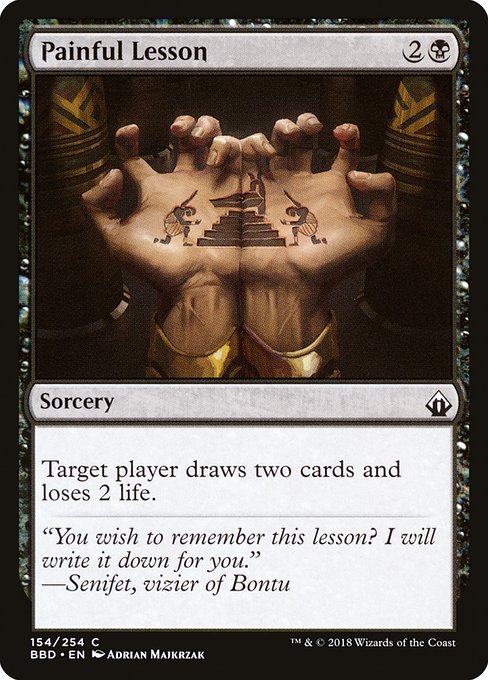
Magic: The Gathering has always balanced sharp mechanics with a wink of humor, and the Battlebond era gave players a flashier stage for those moments. The black spell in question costs 2 generic and 1 black mana (2B) and arrives as a common in a set built for two-headed giants and big, loud table talk. Its effect—Target player draws two cards and loses 2 life—is deceptively simple: a trade-off where you’re essentially buying card advantage at a ticking clock. The card’s humor lies in its blunt math and the social psychology it triggers at the table: would you gamble two cards for a little life debt, or let your opponent pull ahead with a bigger threat looming on the horizon? 🧙🔥💎⚔️
In a two-player game, the decision often boils down to a moment of risk calculus. Draw two cards? Great for cycling through the top of your library, but the price is two life gone. In a commander table, the dynamics shift again: larger life totals, bigger safeguards, and more opportunities to leverage the card draw without feeling the pinch right away. The humor here isn’t a joke at someone’s expense; it’s a shared, tense moment where perception determines the outcome more than pure number crunching. The table becomes a lab of reactions: who brazenly accepts the cost to gain the two cards? Who quietly fences the move and waits for a safer turn? It’s tabletop psychology in a single spell, wrapped in a noir-black mood and a wink to players who enjoy a little misdirection with their mana. 🧩🎲
“You wish to remember this lesson? I will write it down for you.” —Senifet, vizier of Bontu
Flavor text like this anchors the card in a larger mythos. Senifet’s lines steal a page from a grim ledger—memory as debt, lessons as contracts. The art, painted by Adrian Majkrzak, reinforces that mood: a design that nods to the macabre yet wears it with a wry smile. The flavor invites players to read the spell as a moral parable rather than a mere number on a card. That tension—the contrast between the thrill of drawing and the weight of life loss—powers the social experiments at your table as surely as the cards themselves power your deck. 🎨🧙🔥
Why the spell works as a funny card at the table
- Clear choice yet fuzzy outcome: The spell presents a straightforward option—draw two, lose two life—but the result depends on the state of the game and the players’ plans. This ambiguity invites conversation, bargaining, and quick mental math, which tend to be prime soil for table humor and banter.
- Opponents weigh the risk: In casual games, the action can feel like a playful challenge—who’s bold enough to push the “two cards” button and see if the life toll is worth it? In a more competitive setting, the same spell can become a pressure point, prompting a quick bluff or a carefully timed draw.
- Deck-building psychology: The card flips the mental script: card draw isn’t always good—especially if it comes with a price. Players learn to juggle tempo and expansion, balancing the lure of extra options with the danger of slipping behind on the life track.
- Flavor as game theory: The flavor text frames the choice as a moral test, nudging players to consider whether knowledge is worth the cost. The table’s mood shifts from calculation to storytelling, turning a single spell into a memorable moment. 🧙♂️🎲
Design, rarity, and collectability context
Originating in Battlebond, a set known for its two-headed giant focus and draft-friendly design, the card sits as a common rarity. Yet its impact on table talk far outweighs its rarity. The Battlebond era emphasized bold visuals and accessible math, making even a seemingly modest spell feel like a signature moment during a draft or multiplayer event. The set’s emphasis on reprints and communal play helps this spell find its way into a variety of decks long after the initial release, becoming a familiar joke at kitchen-table tables and tournament tables alike. The nonfoil and foil finishes—both available—let collectors and players alike chase the shine, while the price points reflect its status as a fan-favorite for memorable, landmine-like tension. 💎⚔️
Practical notes for modern gameplay
Think about when to cast this spell in your plans. In a vacuum, the two-card draw is appealing, but the life cost can tilt the balance quickly. In a deck that can generate life gain or withstand a bit of life loss, the effect shines as a tool for blunting an opponent’s early pressure or finding needed responses mid-game. In commander or other multiplayer formats, you’ll want to gauge the table’s tempo: is there a chance you’ll draw into a decisive answer, or are you risking an awkward swing that tips the scales against you? The card rewards players who can read the room, respect the risk, and lean into those social micro-decisions that make MTG nights feel legendary rather than routine. 🧙♀️🎨
A playful reminder that MTG is more than math
Humor in MTG often arrives when players notice the tension between “more cards” and “more life lost.” This spell embodies that moment—the classic “do I spend the life to gain the advantage?” dilemma that creates stories you’ll tell at your next pre-release party or LAN night. It’s not just a card; it’s a social experiment in a forest of mana and memory. And in a world where power fantasies collide with practical constraints, funny cards like this one keep the game accessible, letting us savor the drama while we shuffle for the next round. 🧙♂️💬🎲
While you’re planning your next tabletop session, you might also want to protect your gear in style. A sturdy beige circle-dot abstract pattern phone case from Case-Mate can be the perfect companion for a night of lore, laughs, and loud tabletop talk. It’s the kind of accessory that complements long evenings of card-flipping and tabletop strategy—a small nod to the everyday gear that keeps your adventures rolling.