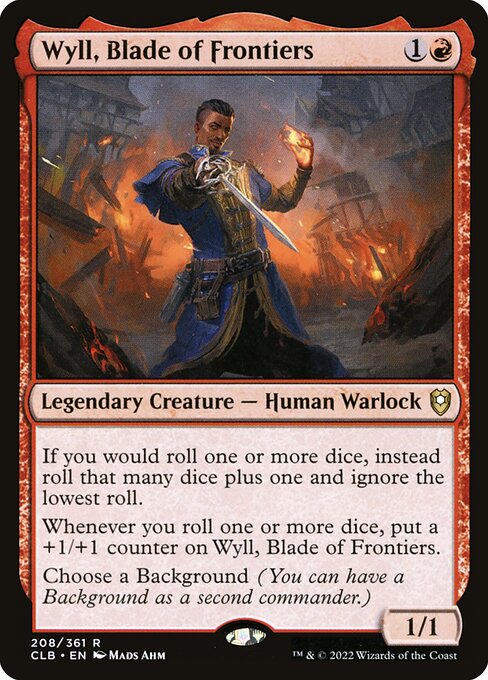
Image courtesy of Scryfall.com
What Wyll, Blade of Frontiers reveals about parody and play
Parody has always hovered at the edge of MTG culture—it's the warm, cheeky wink that reminds us this is a hobby built on imagination, not a sterile math problem. When we talk about parody cards, we’re really talking about the community’s pulse: what jokes land, which crossovers feel earned, and how a game that loves complex strategy can still leave room for mischief and romance. Enter Wyll, Blade of Frontiers, a rare treasure from Commander Legends: Battle for Baldur’s Gate that braids a Dungeons & Dragons sensibility into MTG’s dice-driven drama. 🧙🔥💎⚔️ This card isn’t a joke card, exactly, but it sits squarely at the intersection where lore, luck, and leadership collide—and that tension is what parody cards try to capture in the wild. 🎲
Dice as narrative engines
Wyll arrives with a distinctly red cadence: a cost of {1}{R} for a Legendary Creature — Human Warlock who packs a probabilistic punch. The central mechanic—“If you would roll one or more dice, instead roll that many dice plus one and ignore the lowest roll”—takes a familiar randomness and adds a dramatic twist. In practical terms, you’re nudging odds upward, which can feel like a small victory lap for players who lean into risk and tell a story with their dice. When you couple that with the line, “Whenever you roll one or more dice, put a +1/+1 counter on Wyll,” you’re not just rolling for chance; you’re building an ever-creasing avatar on the battlefield. It’s a design choice that resonates with fans who adore the D&D vibe—the idea that luck is a character you either control or befriend. 🧙🔥🎲
“In a world of fixed numbers, Wyll is a reminder that the story sometimes belongs to the roll of the dice.”
Backgrounds as narrative technology
One of the most intriguing elements of Wyll is the line, “Choose a Background (You can have a Background as a second commander).” Backgrounds are a game design concept that invites you to thread a character’s story into your deck-building. It’s the kind of mechanic that parodies often chase—narrative depth masquerading as a card ability. In the broader MTG culture, this reflects a preference for cohesion between lore and gameplay: when a card feels like a chapter in a larger epic, it invites you to cosplay your table as if you’re at Baldur’s Gate rather than a sterile tournament hall. The ability to pair Wyll with a Background as a second commander is a wink to players who crave storytelling through strategy, and it’s a microcosm of how parody cards function: they celebrate shared worlds while nudging designers to think about how far a concept can be stretched without breaking balance. ⚔️🎨
Cultural resonance: crossovers, humor, and the collector’s gaze
Commander Legends: Battle for Baldur’s Gate sits at a rare crossroads—it's a corner of MTG that leans into narrative depth, cross-property synergy, and the joy of seeing familiar fantasy tropes translated into a new card game language. Wyll isn’t a parody card in the strict sense; he’s a real-world embodiment of a cultural conversation: fans who adore both MTG and D&D find common ground in a single 2-mana red legend who encourages dice-based storytelling. This is precisely the kind of cultural artifact parody cards aim to illuminate: what happens when our toys—the dice, the backgrounds, the big personalities—are allowed to mingle? The result is a deck-builder’s dream and a lore-lover’s treasure, with the EDH community appreciating a card that is both flavorful and functional. The card’s EDHREC rank (3684) hints at its reach within the Commander scene, where quirky synergy and narrative glue often push a card from “nice to have” to “must-explore.” 🧙🔥💎
Practical takeaways for builders and commentators
- Embrace the dice-forward identity: Wyll rewards risk and storytelling. When you craft a deck around him, look for dice-centric interactions that turn every roll into a small arc of the game. Pairing high-variance effects with reliable counters can create memorable comebacks or devastating finishes.
- Claim a story with a Background: The option to choose a Background as a second commander invites you to design a theme that’s more than just a color identity. Think about protagonists from your tabletop games or fantasy novels and translate their vibe into a deck’s strategy and flavor.
- Balance humor with utility: Parody-influenced design thrives on playful assumptions about what the game is “allowed” to do. A well-tuned card like Wyll shows how humor can coexist with depth—giving players something interesting to pilot without collapsing the rules.
- Celebrate cross-media love: The blend of D&D lore with MTG mechanics is a reminder that the multiverse thrives on collaboration. It’s why players collect, trade, and debate around cards that feel like they could stroll out of a fantasy novel into a kitchen-table match.
- Market and meta awareness: As a rare from a beloved crossover set, Wyll has collector weight, but it’s also a reliable build-around option for red-focused strategies that enjoy dice-empowered growth. The card’s price ceiling remains modest for most players, but its value grows in casual and Commander circles where flavor and theme reign supreme. 💬
From parody to practice: weaving a little magic into your setup
For those who don’t do full Commander decks but love the vibe, Wyll exemplifies why parody and crossovers matter. They teach us to read the room: what jokes land, what mythologies pair best with mechanics, and where players want to take their tables next. The tale of Wyll also hints at a broader truth: MTG culture loves to celebrate the narrative alongside the numbers. It’s why, even in heatedlich meta discussions about card power or tournament viability, the community rallies around moments that feel like fan-fiction becoming official. And if you’re hunting for a practical desk companion during long drafting sessions or heated debates about dice fairness, a well-chosen mouse pad can be your quiet ally—hence the featured product below. 🧙🔥🎲
As you explore parody through the lens of official crossovers, you’ll notice a shared thread: the appreciation for world-building that can be translated into strategic craft. Wyll, Blade of Frontiers stands as a small beacon—proof that a card can be deeply thematic, mechanically intriguing, and a doorway to conversations about culture, community, and what we value when we reach for that next draw step. And if you’re ready to level up your table experience while you plan your next Wyll-enabled narrative, consider the practical gear that keeps you comfortable through endless turns and big moments. 💎⚔️