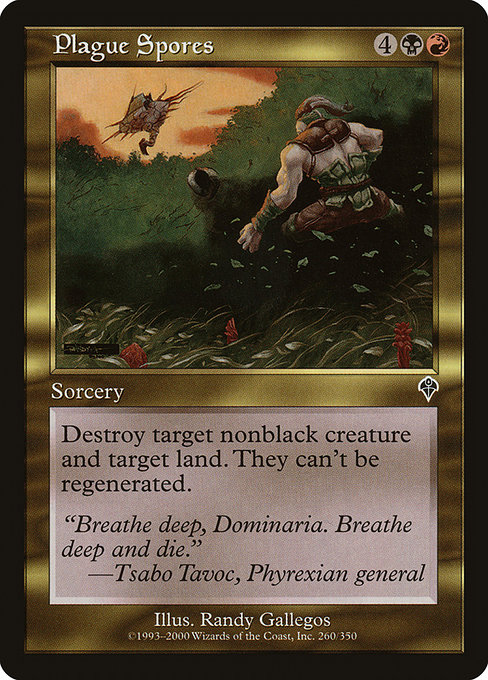
Image courtesy of Scryfall.com
Economic Analysis of Sealed Product Scarcity in MTG
Today’s market isn't just about rare cards and flashy combos; it’s also about the quiet economics that keep sealed product in motion even when the commons of yesterday can feel like a nostalgia tax. Plague Spores, a multicolored gem from the Invasion era, serves as a curio for examining how scarcity in sealed product works in practice. 🧙🔥 The way a single card’s demand persists in Legacy or Commander formats interacts with the lifecycle of the entire booster ecosystem, shaping price signals that fans, speculators, and retailers keenly watch. 💎
Plague Spores: a quick refresher
Plague Spores is a sorcery from the Invasion set (INV), with a mana cost of {4}{B}{R} (a six-mana commitment in the pre-errata world where mana efficiency often dictated deckbuilding choices). It’s color-identity is red and black, and its printed rarity is common. The card’s text is straightforward but potent: Destroy target nonblack creature and target land. They can't be regenerated. In a game that often rewards removal and tempo, a spell that pivots the battlefield by erasing a problematic creature and a land—and denying regeneration—has a certain raw, late-20th-century brutality. Flavor text reinforces the era’s grim sense of inevitability: “Breathe deep, Dominaria. Breathe deep and die.” Tsabo Tavoc’s voice is the prologue to a longer saga of phyrexian pressure and strategic disruption. 🎲
Scarcity dynamics: why older sealed product matters
Sealed product scarcity isn’t just about the card you pull; it’s about what you can’t quite find on shelves today. Invasion-era boosters, booster boxes, and product from that generation carry a unique scarcity profile for several reasons:
- Age and degradation: Two decades can wear outer packaging, shrink wrap, and the storage environment. Boxes may survive, but their resale viability depends on whether collectors expect to break a seal. That physical decay creates price floors for what remains sealed, even when individual cards are cheap. 🧭
- Print runs and reprint risk: Wizards of the Coast’s printing philosophy has shifted over the years. While some sets see robust reprint treatment (think of recent Standard staples), long-ago sets like Invasion often don’t see mass reprints, outside of niche reprint cycles or special products. This means sealed product from those sets can remain comparatively scarce even if the singles market for common cards like Plague Spores stays low. ⚔️
- Format-driven demand: Invasion cards are Legacy/Vintage friendly and can filter into Commander as well. A multisource demand signal—tournament play, casual play, and collector curiosity—keeps sealed boxes relevant. The rarity of the card itself in singles doesn’t necessarily translate to sealed value, but the sealed ecosystem benefits from ongoing interest in the era’s design and lore. 🧙♂️
- Nostalgia and collector culture: There’s a flavor to the old-border era that fuels collecting as a hobby, not just as an investment. Nostalgia becomes a durable market force, especially for players who started in the late 1990s and early 2000s and now want tangible reminders of that time. 🎨
: Sealed product ties up capital longer, and storage costs (temperature-controlled rooms, humidity management, and security) add up. That friction can depress liquidity but can also bolster price stability for the right items, especially for boxes that are visually appealing or feature sought-after set symbols. 🧱
What the numbers can tell us (and what they don’t)
Looking at price data for the card itself offers a clue but not a full map. For Plague Spores, the singles market shows modest values—typically a few pennies for nonfoil copies and a handful of dimes for foils, with fluctuating tick-ups in response to specific demand. In the sealed market, however, the signal is less about the card’s own price and more about the surrounding supply chain: how many booster boxes of Invasion remain unopened, how many have been opened and sold as singles, and how many have survived in collector-grade forms. In that context, scarcity risks are asymmetric: a stale sealed box might hold more speculative premium than a stack of commons, because collectors prize the unopened artifact as a physical time capsule. 🧨
Strategic takeaways for collectors and players
: If you’re playing Legacy or vintage formats or simply collecting, don’t place all your chips on a single card—especially a common from an older set. Look at sealed boxes, product bundles, and complete collections to gauge real scarcity. 💎 : Proper storage preserves value. Humidity control and secure shelving aren’t glamorous, but they’re cheaper than chasing replacement copies later. 🧳 : Reprint trends can turbocharge or depress sealed value. A surprising reprint of a beloved era can flood the market, while a long drought can tighten it. Stay aware of Wizards’ product announcements and Masters sets that have historically touched older formats. 🧭 : If you’re building a dedicated MTG workspace, upgrading your setup can feel as satisfying as drafting the right deck. For example, pairing a pristine play space with a neon, high-visibility mouse pad keeps your desk as iconic as your card collection. This is where a little lifestyle merchandising intersects with gaming culture. 🧙♀️🎨
“Scarcity isn’t a single-number metric; it’s a story about how supply, demand, and human behavior intersect over time.”
In the end, the Plague Spores case study isn’t just about one card in one set. It’s a lens into how sealed product scarcity functions across eras. The dynamics—age, storage, reprint risk, format demand, and collector culture—combine to shape price signals that affect everything from booster packs to playmats, from the speculative dashboards to the casual buzz in chat rooms. And as players sharpen their edges with brutal removal magic and land-snuffing sorceries, the market keeps rotating, driven by a shared love for a game that thrives on stories as much as on cycles and counters. 🧙♂️💥
If you’re looking to invest a little into the daily ritual of MTG collecting—and maybe upgrade your desk at the same time—check out this sleek non-slip gaming mouse pad designed for neon-lit nights and marathon drafting sessions. It’s the kind of product that turns a hobby into a better desk hobby.