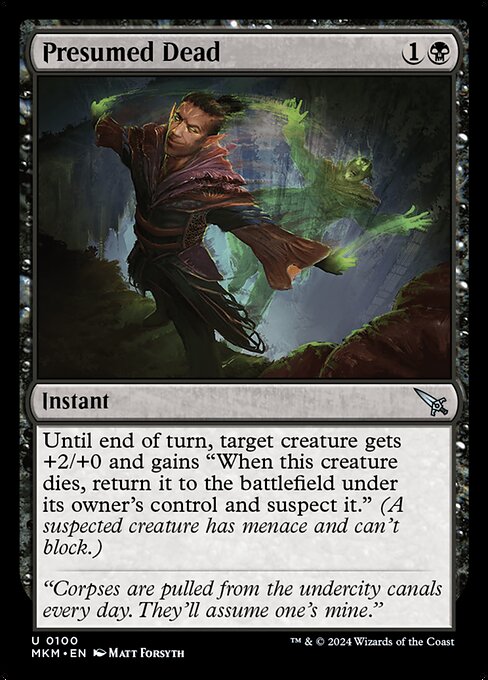
Image courtesy of Scryfall.com
Rarity, Perception, and the Psychology of Collecting in Magic
Rarity isn’t just about how many copies exist in a set; it’s a living discipline that shapes our play, our trade, and even our daydreams about the next big pull. In Magic: The Gathering, the moment a card lands on a table, the chatter begins: is this common, uncommon, rare, or mythic? Does rarity reflect power, or does it merely reflect a marketing whisper we’ve all learned to listen for? 🧙🔥 The answer isn’t simple, but it is endlessly fascinating, because rarity acts as both compass and lure for players who love the game for its strategy, lore, and culture. This is especially true when we peek at cards from newer sets that push the boundaries of what “uncommon” can do in a world of mythic-scale expectations. 💎⚔️
Presumed Dead: a case study in rarity and design
From the Murders at Karlov Manor expansion, Presumed Dead is a compact black instant that wears its uncommon badge with a sly wink. Costing {1}{B} and offering a temporary stat boost of +2/+0 to a single target creature, it also grants an unusual, long-term twist: when that buffed creature dies, it returns to its owner’s battlefield and becomes “suspect.” In MTG-speak, a suspect creature has menace and can’t block. That isn’t merely flavor; it’s a deliberate design choice that hybridizes tempo with late-game inevitability. The card’s flavor text—“Corpses are pulled from the undercity canals every day. They’ll assume one’s mine.”—is a moody wink to Karlov Manor’s gothic atmosphere, and it suggests a world where scarcity and secrecy are currencies as valuable as gold. 🎨🧭
Rarity influences both how often you can deploy Presumed Dead in a given deck and how often you’ll encounter it across a draft table or a trade bind. In Limited environments, a well-timed instant that pushes a creature’s power for a turn while setting up a future replay can swing tempo decisively. In Constructed formats, the card’s uniqueness—granting a creature a lasting, even if conditional, upside—can create interesting value in midrange or aristocrat-style decks that lean on recursions, fliers, or value engines. The uncommon slot is a sweet spot: not so scarce you’re chasing it forever, but rare enough to give a sense of discovery when you pull it from a pack or slide it into a trade. 🧙♂️💎
- Power versus rarity: Presumed Dead demonstrates how an uncommon can deliver straightforward burn-and-buff tempo while offering a strategic resurrection theme that fits Karlov Manor’s noir vibe. The ability to reanimate a creature later—albeit as a suspect—drives decisions about blocking, trading, and enemy timing. It’s a reminder that “power for price” isn’t a straight line; sometimes a card’s true value lies in how it reshapes a board state across multiple turns. ⚔️
- Foil versus nonfoil: With foil versions fetching a touch more in some markets, rarity nudges collector interest toward shiny versions, even when the gameplay value remains modest. The data hint at modest price points for Presumed Dead in both foil and nonfoil forms, which aligns with its uncommon status and steady appeal for collectors who love the Murders at Karlov Manor feel. 🎲
- Flavor and art as rarity accelerants: The art by Matt Forsyth captures a decadent, candlelit undercity mood, ripening the perception that uncommon cards are often the most characterful. When the art rewards a second look—an eager buyer noticing the texture of the illustration and the story behind it—the card’s perceived value climbs beyond the numbers on the page. 🎨
Rarity as a social contract among players
Rarity shapes how we talk about cards, trade for them, and teach new players what “collectible” means in practice. When a card comes from a vivid, story-laden set like Murders at Karlov Manor, rarity becomes a signal of a card’s place in the broader narrative—how it fits into the lore, how it might interact with other cards in a deck, and how it could become a catalyst for memorable games. The inclusion of Presumed Dead, with its “suspect” mechanic, adds a layer of tactical storytelling: you buff a creature, it fights bravely, then fate intervenes in a way that blurs the lines between ownership and the battlefield. The result is a psychology of scarcity that’s both practical at the table and poetic in its flavor. 🧙♀️💎
“Corpses are pulled from the undercity canals every day. They’ll assume one’s mine.”
In this sense, rarity isn’t just about how rare a card is—it's about how rare the experience is that it enables. A well-timed Presumed Dead can turn a stalled board into a flurry of choices: do you push for damage before the suspect returns, or do you set a trap for your opponent’s blockers? The card invites players to measure risk, reward, and timing in a way that mirrors the very human experience of collecting: we chase the unknown, the next discovery, the thrill of a good fetch or a well-played bluff. 🧠🎲
Tactics, portfolios, and the culture of collecting
From a gameplay perspective, Presumed Dead asks players to think about tempo, parity, and the value of a multi-turn plan. It’s not just a one-off play; it can court a sequence of outcomes that hinges on the peculiar “suspect” condition. That makes it an interesting option in black-heavy archetypes that like to push through damage while puncturing an opponent’s lines with ephemeral threats. For collectors, the card’s uncommon status, combined with its foil potential and the evocative flavor text, makes it a compelling keeper in the Murders at Karlov Manor portfolio. The set’s gothic theme and Forsyth’s art help create a cohesive story arc that fans may want to track card-by-card as the lore grows. 🧙♂️🧭
For players who enjoy the social aspect of MTG, the cross-promotion angle here is worth noting. While Presumed Dead lives in a world of cards and moments, the product link below invites fans to explore gear that supports their hobby on the go—whether you’re traveling to a store, a weekend tournament, or a casual night with friends. It’s a reminder that the MTG lifestyle includes the gear we carry, the trades we make, and the memories we build around each spark of play. 💎🎨