Image courtesy of Scryfall.com
Rarity Signals and the Subtle Craft of MTG Design
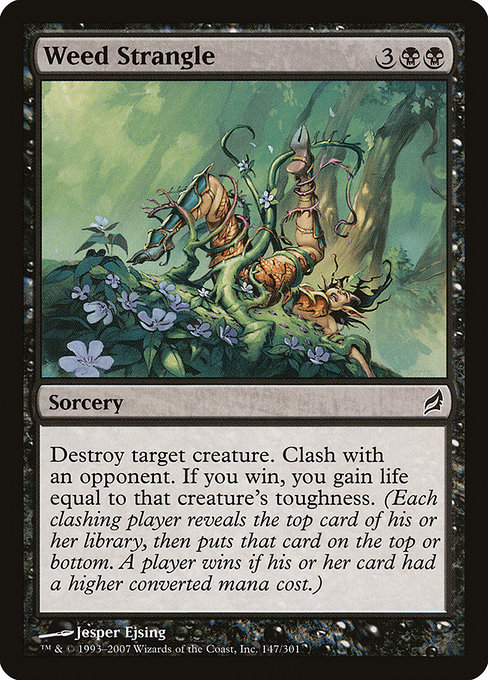
Magic: The Gathering has always spoken a visual language alongside its rules text, and rarity indicators are a quiet but telling part of that conversation. The color of the expansion symbol, tucked near the bottom of a card, signals whether a card is a common, uncommon, rare, or mythic rarity. That tiny color cue influences drafting expectations, pricing, and even how players perceive a card’s power before a single mana is spent. In Weed Strangle, a Lorwyn-era available-for-draft sorcery, you can feel that design intent at a glance: a solid, budget-friendly black spell that still leaves an aroma of crunch and consequence. 🧙♂️
Weed Strangle is a black mana card with a hefty mana cost of {3}{B}{B}, classifying it as a five-mana spell with a significant impact. The card’s rarity is listed as common, which aligns with its straightforward removal effect and the “clash” mechanic it sports. The clash mechanic—both players reveal the top card of their library and compare mana values—adds an element of risk and excitement to what would otherwise be a clean wipe on the board. If you win the clash, you gain life equal to the destroyed creature’s toughness. That life swing is the kind of twist black can squeeze into a common slot, turning a pure removal into a small, tense reward. ⚔️
From a design language perspective, Weed Strangle embodies how rarity indicators guide expectations. Common cards tend to offer efficient, dependable effects that players can rely on across many games and formats, especially in draft and limited play. Weed Strangle delivers immediate creature removal, a classic Black staple, and then layers in a thematic consequence through the clash and life gain. The result is a compact package that feels both flavorful and practical—the hallmark of effective rarity translation from concept to cardboard. The set Lorwyn, where this card was printed, emphasizes a warm, intricate world where even a dark spell can feel balanced and flavorful within the environment. 🎨
“Rarity isn’t just about price; it’s about how a card’s power and flavor scale with your deck strategy.”
In this design space, Weed Strangle also demonstrates the tension between a card’s raw power and its accessibility. The spell is blueprints-simple in text, yet its flavor—Weed Strangle choking a foe’s capabilities—lands with a satisfying thematic punch. The card is a reminder that rarity indicators serve as a map: common slots should be approachable, foils snappy, and mana costs approachable enough to encourage experimentation in limited formats. The Lorwyn printing, with its distinct frame and illustrated vibe by Jesper Ejsing, helps ensure that even a five-mana black spell retains a place in a player’s mind as a reliable, flavorful tool rather than a one-off novelty. 🧙♂️🔥
From a collectibility angle, Weed Strangle’s common status is reinforced by price data that shows steady accessibility. Current market glimpses place nonfoil copies around a modest value, while foils command a premium due to the rarity and the tactile allure of foil finish. The card’s foil-versus-nonfoil differential reflects a broader truth in MTG collecting: even within a common rarity, print runs, condition, and foil treatment shape a card’s long-term value, especially for sets that enjoy robust casual play and ongoing reprints. The balance between cost, playability, and aesthetic appeal keeps Weed Strangle relevant for players who enjoy both functioning decks and the chance to showcase a well-worn favorite in a list that’s part nostalgia, part strategy. 💎
For players who are tuned into the broader conversation around scarcity and value, Weed Strangle offers a microcosm of how rarity indicators interact with deck-building philosophy. The card’s black mana identity, its five-mana commitment, and its dual-mode payoff—destroying a creature and testing a clash—encourage thoughtful play plutôt than brute-force removal. It’s the kind of design that rewards players who respect both the engine and the edge: the engine of the card’s effect and the edge of the life swing that can tilt a late clash in your favor. The lore of Lorwyn—an environment that feels equal parts hearth and whimsy—gives Weed Strangle a place in the hall of cards where flavor and function happily coexist. 🧙♂️⚔️
As designers continue to refine the craft, looking at cards like Weed Strangle through the lens of rarity helps explain why some cards feel timeless while others seem ephemeral. The expansion symbol’s color, the frame style, and the mechanical complexity all come together to guide new players into a world where "common" is not equal to "perfunctory." It’s a reminder that every MTG rarity level carries a design philosophy, and when those philosophies align with a card’s theme, the result is something players return to—week after week, draft after draft. 🔥🎲
Curious readers who want to explore more about how digital and physical MTG content intersects with design, scarcity, and culture might enjoy a few related reads from our network. Check out the curated list below for a broader look at digital art, card strategy, and the economics of in-game ecosystems. 🧙♂️💎
Clear Silicone Phone Case — Slim Durable ProtectionMore from our network
- https://blog.digital-vault.xyz/blog/post/how-to-create-digital-wall-art-that-sells/
- https://blog.rusty-articles.xyz/blog/post/chandra-and-friends-recurring-red-legends-of-lava-spike/
- https://crypto-acolytes.xyz/blog/post/gala-vs-vulcan-forged-which-nft-game-platform-wins/
- https://crypto-acolytes.xyz/blog/post/ethereum-vs-solana-meme-coins-which-reigns-supreme/
- https://crypto-acolytes.xyz/blog/post/unpacking-the-secondary-effects-of-in-game-inflation-on-players/