Image courtesy of Scryfall.com
Rarity, Cost, and the Allure of Scaling Power
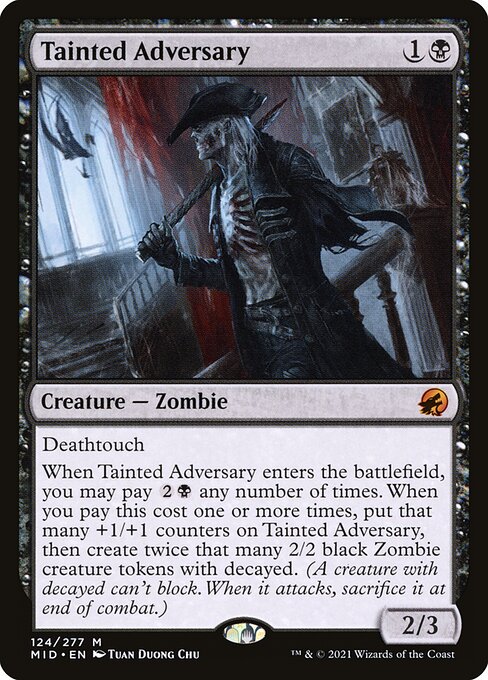
Magic: The Gathering has long teased a relationship between how rare a card is and how much you can bend its baseline power with mana. Tainted Adversary—hailing from Innistrad: Midnight Hunt as a mythic rarity—puts a twist on that expectation. For a humble {1}{B} investment, this 2/3 with deathtouch already earns a place in many black decks. But the real thrill comes when you start paying {2}{B} repeatedly as it ETBs (enters the battlefield). Each payment amplifies the Adversary’s strength and multiplies the board presence in a way that only a mythic can pull off. It’s a design that rewards ramp, planning, and a touch of audacity 🧙♂️🔥💎⚔️.
Card Snapshot
- Name: Tainted Adversary
- Set: Innistrad: Midnight Hunt (MID)
- Rarity: Mythic
- Mana Cost: {1}{B}
- Type: Creature — Zombie
- Power/Toughness: 2/3
- Keywords: Deathtouch
- Oracle Text: Deathtouch. When this creature enters, you may pay {2}{B} any number of times. When you pay this cost one or more times, put that many +1/+1 counters on this creature, then create twice that many 2/2 black Zombie creature tokens with decayed. (A creature with decayed can't block. When it attacks, sacrifice it at end of combat.)
Mechanics Deep Dive
Let’s unpack what that on-entry ability looks like in practice. Starting as a 2/3 with deathtouch, Tainted Adversary becomes a scaling threat the moment it lands. If you pay the kicker once, you add a +1/+1 counter, lifting it to a sturdy 3/4, and you spawn two 2/2 decayed Zombies. The tokens themselves are not simply extra bodies; their decayed status creates a built-in tempo check. They’ll swing and inevitably sacrifice at end of combat, but in the meantime they press your battlefield advantage, threaten planeswalkers, and siphon removal away from your prized Adversary.
Pay twice, and you’re looking at a 4/5 Adversary (2 + 2 counters) with four 2/2 decayed zombies. The math scales quickly: N payments grant +N/+N counters on the Adversary and produce 2N decayed Zombies. The decision to invest is all about timing and the state of the board. Do you invest early to dominate the midgame, or wait for the perfect moment to surprise opponents with a blowout swing? The deathtouch clause ensures trades favor your zombie overlord, making even fights with larger blockers feel manageable when you’ve stacked enough +1/+1 counters.
This is a quintessential example of how rarity and mana cost collaborate in contemporary design. The base cost is accessible, but the ceiling is mythic-level—creating a dynamic where the card’s influence scales with the player’s mana management, not just its raw stats. It’s a lesson in how a single card can reward both careful planning and bold experimentation 🧙♂️.
Strategic Roles in Limited and Constructed
In Limited play, Tainted Adversary is a compelling anchor for black decks that lean into early removal and late-game inevitability. Its ability to generate tokens gives you reach even if the initial board state looks quiet. The deathtouch trait adds a tactical edge in trades, helping you cut down tempo by forcing opponents to allocate resources to remove or block the Adversary. You’ll often see players invest once or twice to sculpt a midrange board that can threaten lethal assaults in the following turns.
In Constructed formats, the card shines in zombie-oriented shells and sacrifice-enabled archetypes. The Deathtouch tackle on a resilient body means the Adversary can trade up in combat while you lean on your reservoir of mana to blossom its counters. The generated decayed Zombies invite familiar sinergies: sacrifice outlets that reward you for sacrificing creatures, or ways to flood the board with expendable bodies while keeping the Adversary alive and growing. It’s not just a beat-stick; it’s a scalable engine that can overwhelm defenses as the game unfolds. The balance—decayed tokens that can’t block and must be sacrificed at end of combat—keeps you honest and creates a window for careful attack sequencing.
Rarity, Value, and Set Design
Mythic rare cards, by design, offer a higher ceiling and a touch of narrative spectacle. Tainted Adversary embodies that ethos: low upfront cost, high later payoff, and a flavorful hook that hints at a darker Underground of Innistrad’s zombie economy. The rarity signals to players that this is a card likely to see a fair share of play in decks built around reanimating or capitalizing on token bodies, while the scaling mechanic invites experimentation with different mana curves and combat cadences. Market data from Scryfall places it at a modest price point for a mythic—accessible for most collectors who want a slice of Midnight Hunt’s gothic aura without breaking the bank. In short, it’s not an overpowered radius that invalidates standard games, but a card that rewards smart timing and clever deck-building 🧙♂️🎨.
Practical Takeaways for Your Deckbuilding
- Leverage a steady mana base to pay {2}{B} multiple times when the board state supports it, turning a single investment into a multi-turn threat wave.
- Pair with sacrifice outlets to recoup value from the decayed tokens or to churn extra value from your engine pieces.
- Use deathtouch to maximize favorable combat trades, especially when your Adversary has grown through counters.
- Think of it as a two-stage threat: the Adversary itself grows, while the tokens provide pressure and reach that can force opponent mistakes.
For fans who enjoy the tactile thrill of a carefully curated board,” Tainted Adversary” hits that sweet spot between budget-conscious play and a satisfying, scalable payoff. It’s a card that wears its mythic heart on its sleeve—darker, more tactical, and a little delightfully unpredictable 🧙♂️🔥.
While you mull over board states and likely lines, you can also level up your gaming setup with gear that keeps you comfy during long sessions. Check out the Neoprene Mouse Pad—round, rectangular, non-slip—to ensure your cards and calculator never slide off your table during a decisive moment of combat.