Image courtesy of Scryfall.com
Rarity vs Usability: A Strategic MTG Look at Esper Cards
When you think about Esper in the Magic: The Gathering multiverse, the mind often lands on blue-white-black control, artifacts humming in the background, and careful resource management that can outlast even the most stubborn opponents. Yet within the March of the Machine Commander release, one common-plane card quietly showcases a revealing truth about rarity and usability: rarity does not dictate impact, especially in archetypes that lean on synergy, chaos, and planewide moments. This article dives into that dynamic through the lens of a colorless, planarly flavored card that sits at the crossroads of artifact shenanigans and chaotic twists 🧙♂️🔥💎⚔️🎨🎲.
Common but surprisingly potent: the hidden strength of rarity
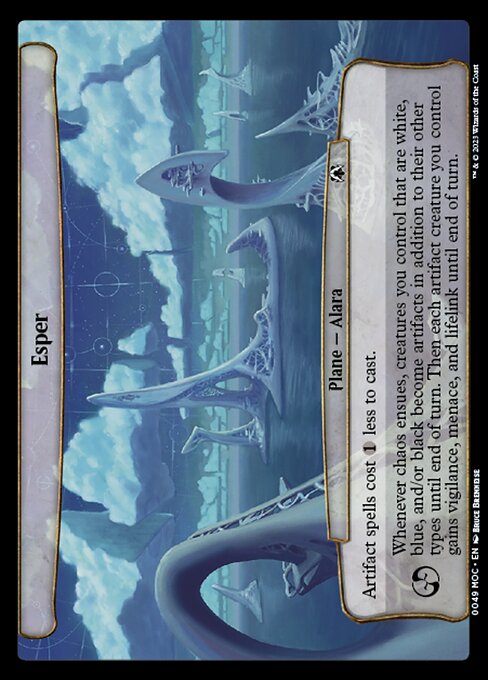
Esfér (the Plane — Alara) from the March of the Machine Commander collection presents a rare pairing of utility and whimsy. It’s classified as a common, yet its Oracle text rewards players who think in terms of tempo and board-sate control rather than raw card advantage. The card’s mana cost is 0, and it isn’t tied to a specific color identity, which in practical terms means it can slot into a wide range of commander shells that lean into artifact synergy or chaos triggers. The rarity designation—common—often signals a lower expectation for impact, but in the right deck, such cards punch well above their weight class, especially in \u00a0types and themes that reward broad participation from multiple card types and synergies. In Esper contexts, that means artifact-heavy strategies and chaos-engendered board states can turn a seemingly modest card into a recurring engine 🧙♂️💎.
Reading the bones: how the card actually plays out
The plane reads as a two-part engine. First, artifact spells cost {1} less to cast. That is a straightforward mana acceleration that incentives you to lean into artifact-focused spells, drawers, and engines. In a typical Esper shell—blue, white, and black combinations that love control, recursion, and artifact-backed tempo—this discount can be the nudge that makes your favorite artifact-centric combos run more smoothly on curve. Second, and perhaps more evocative, is the chaos-driven clause: when chaos ensues, creatures you control that are white, blue, and/or black become artifacts in addition to their other types until end of turn. Then, each artifact creature you control gains vigilance, menace, and lifelink until end of turn. This is not merely a flavor moment; it’s a transition into a temporary autonomous artifact army that can swing, block, and drain life with a single chaos event.
Notice how the card’s power scales with the chaos mechanic and artifact identity. If you lean into artifact creatures or have a board full of white/blue/black creatures, this Plane can transform those creatures into artifacts mid-turn, effectively converting them into a temporary power bloc while granting powerful evergreen keywords to your artifact creatures. The synergy is particularly potent in Commander formats, where chaos-style stakes, sudden tempo swings, and wide board states are common. It’s a thoughtful example of how a common rarity can enable a deck’s core strategy without requiring you to chase a high-pick mythic slot—the kind of design elegance that makes casual play feel like a thrilling challenge 🧙♂️🎲.
Design, colorless identity, and practical usage in Esper builds
One of the most interesting facets here is how a colorless, planary effect interacts with the characteristic Esper flavor. In many Esper builds, you’ll find a focus on artifact synergies, bounce effects, and control-oriented packages, all of which can leverage cheaper artifact spells and a temporary artifact-state from chaos events. The card’s lack of color identity is a feature, not a bug, because it broadens compatibility with a wide range of detected archetypes—from artifact-heavy tempo to broader chaos-oriented strategies—without forcing a specific color scaffold. This is a reminder that rarity is a separate dimension from usability: a common card can be a strategic cornerstone if its text aligns with the deck’s plan and the commander’s goals. Even for collectors, the common slot can represent a low-cost, high-utility piece that serves as a reliable anchor in a chaotic, artifact-friendly lineup 🧙♂️⚔️.
From a design perspective, this card also highlights how rarity interacts with board state volatility. The discount on artifact spells is a durable payoff, while the chaos-triggered artifact turn elevates temporary board presence, providing a burst of offensive and defensive utility that can shift the opponent’s plan. It’s the kind of layered interaction that designers adore: a stable, repeatable source of mana efficiency fused with a surprising, situational surge that rewards timing and target selection. The result is a card that invites experimentation in Esper-friendly shells and beyond, encouraging players to explore how chaos mechanics can be leveraged to maximize artifact output and strategic tempo 🔥🎨.
Strategic takeaways for players and collectors
- Rarity is not a constraint on impact: Common cards can unlock meaningful lines when their text aligns with a deck’s themes, especially artifact-centric and chaos-tinged strategies.
- Artifact economy matters: The artifact-cost discount is a genuine engine in any deck that already plays artifacts. Every artifact spell you cast for less mana compounds the turn’s tempo advantage.
- Chaos as a design lever: The temporary upgrade of white/blue/black creatures into artifacts, plus their gained keywords, can swing a game if you’ve set up a fertile battlefield for artifact creatures to thrive.
- Esper synergy goes beyond colors: With the right shell, even a colorless card contributes to an Esper strategy that thrives on control, disruption, and mid-to-late-game artifact finisher lines.
- Collector perspective: While the card is budget-friendly (prices around a few dollars or less depending on market fluctuations), its real value lies in playability within casual to semi-competitive Commander circles, where theme and synergy reign supreme 🧙♂️💎.
Beyond the table, the parallel between rarity and usability resonates with how fans curate their collections and build their boards. It’s not about chasing the rarest slot in the binders; it’s about identifying the right card at the right moment—one that can turn a plan into a plan with a few decisive moves. And if you’re rounding out your desk setup or seeking a tactile companion for glistening board states, consider pairing that focus with something practical at home—like a non-slip mouse pad that keeps your hands steady during those tense, twist-filled turns. Your table deserves a little command center magic 🧙♂️🎲.
For players who want to explore more about the intersection of rarity and usability in Esper and artifact-driven decks, keep an eye on the broader Commander landscape and how chaos-oriented planes alter the value of your spells and creatures. The card in focus is a gateway to that exploration—a reminder that in Magic, even the modest can become mighty under the right set of circumstances.