Image courtesy of Scryfall.com
Reading the Room: Reborn Hero and the Inclusion Debate
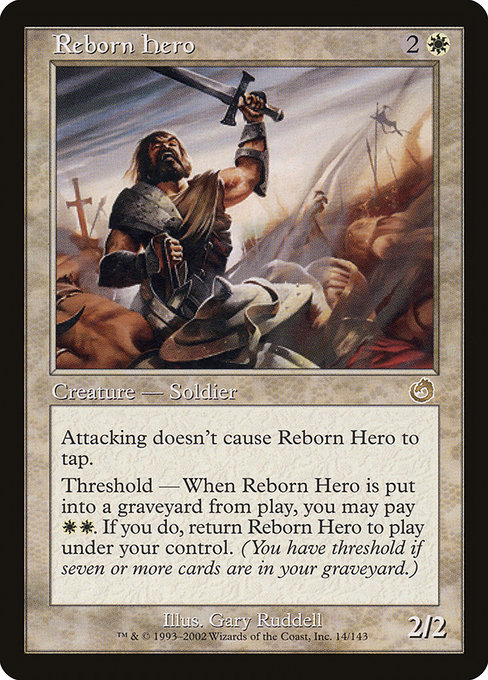
In the grand tapestry of MTG, a card’s value isn’t measured by raw power alone—it’s how well it harmonizes with the deck you’re piloting and, equally important, how often you can reliably bring it to bear when the game demands it. Reborn Hero, a rare from Torment, is a perfect case study for talking about inclusion rate and its impact on win probability. This white creature—a compact 2/2 with vigilance for {2}{W}—isn’t just a body on the battlefield. It sits at the intersection of board presence and a self-contained recursive engine, provided you’ve built toward a seven-card graveyard. 🧙🔥💎⚔️
White often shines in creating resilient, value-driven boards, and Reborn Hero embodies that ethos with a twist. Its vigilant early stature lets you swing or hold up mana safely, while its Threshold ability—“When this creature dies, you may pay {W}{W}. If you do, return this card to the battlefield under your control”—transforms a modest investment into recurring presence. The real story here isn’t a flashy drop on curve; it’s the quiet math of inclusion rate: how often you include Reborn Hero in your 60-card builds (or your 100-card Commander hull) and how quickly you can propel it into a truly recursive threat. 🧙🎲
How the Threshold Mechanics Shape Win Conditions
Threshold is the engine that makes Reborn Hero more than a vanilla chump blocker. As long as seven or more cards lie in your graveyard, the card’s returning capability is online—an important gating condition that rewards careful graveyard management. The decision to recast the Hero carries real tempo implications: you’re not just reanimating a creature; you’re effectively reigniting your board with a new threat each time you pay the mana. The cost is modest, but the payoff hinges on your ability to control the graveyard. In practice, this means your inclusion rate should align with your strategy for refilling the graveyard and protecting the Hero long enough to secure a second—sometimes even a third—arrival. 🧙💎
“The graveyard is a resource you build, not a place you abandon.”
That sentiment rings true here: you’re building a small engine inside a larger plan. If your deck already leans into graveyard synergy—whether through recursion-centric white strategies or complementary color pairs—the Hero’s recast option becomes a reliable option rather than a one-off trick. The more often you include it in your decks, the higher the probability that you’ll encounter a situation where seven graveyard cards are in place the moment it dies. In Commander, where you typically see 100-card decks and a singleton copy, your inclusion rate is more about consistency across your meta than raw draw odds. ⚔️
Strategies for Maximizing Inclusion Rate and Win Probability
- Graveyard acceleration matters. If your plan is to push seven cards into the graveyard quickly, Reborn Hero becomes a trustworthy engine. Include enablers—things that reliably push cards to the graveyard—without sacrificing your own plan.
- Protect the Recursion Window. The return ability only matters if the Hero dies when the threshold is active. Build around ways to ensure it dies with your graveyard primed, whether through favorable trades, targeted removal on opposing threats, or effects that force your opponents to interact with your battlefield.
- One copy, big impact (in singleton formats). In most Commander decks, you’ll likely run just one copy of Reborn Hero. The efficiency of your inclusion rate then hinges on how often you can enable the threshold by the midgame and how well you can weave the Hero back into post-board states. 🧙
- Deck archetypes that sing with thresholds. Aggro-white shells that stack cheap threats and value engines, or control-slanted builds that leverage graveyard filler to unlock late-game recursions, are natural homes for this card. Even if you don’t win with a straight beatdown, the Hero’s recast can create relentless, tempo-shifting pressure. 🎨
Practical Takeaways: When and Why to Include
For a 60-card, traditional constructed approach, Reborn Hero can serve as a resilient, midrange curve-topper that weathered old-school board wipes and still bounces back into the fight. In a Commander setting, you’re weighing the one-copy expectation against the chance to repeatedly recur it, provided your graveyard fills. If your strategy already includes ways to populate the graveyard, adding Reborn Hero is less about sheer power and more about converting late-game inevitabilities into recurring threats. In that context, increasing your inclusion rate—i.e., choosing to run it in more of your decks—meaningfully lifts your odds of creating a game-defining moment where you recast a 2/2 vigilance creature, again and again. 🧙🔥
From a collectible and market perspective, Torment’s Reborn Hero sits in a region of the spectrum where nostalgia meets value. It’s not the priciest rare on the shelf, but its art by Gary Ruddell and its memorable threshold interaction keep it relevant for players seeking a classic white recursion piece. Current price data positions nonfoil around a comfortable baseline, while the foil version nudges higher for players chasing that glossy reunion with the past. Even if you’re not jamming this exact card every week, it’s a strong reminder of how inclusion rate—when paired with a well-timed threshold moment—can swing a match, especially in formats that reward resilience and repetition. 🧙💎
For those curious about where to pick up this piece or similar growth opportunities, the broader MTG market has a spectrum of options. The card remains a collectible artifact from Torment, and while the price won’t break the bank, its practical impact in the right deck can feel priceless. If you’re looking to test the waters with your own Reborn Hero build, a great way to start is by evaluating your graveyard-filling lines and how quickly you can push toward seven cards by midgame. The interplay between opportunity and timing here is a microcosm of MTG deckbuilding: the better you orchestrate inclusion, the more often you’ll watch a small creature become a recurring, unexpected winner. 🧙🎲
Ready to explore more ways to level up your MTG game and keep a keen eye on the meta? Our curated picks and guidance pair nicely with a simple, reliable accessory that’s always handy for a busy gamer on the go. Because great decks deserve great protection—and your phone deserves a case that’s as sturdy as your ladder climb.