Image courtesy of Scryfall.com
Two Traditions, One Frame: The Draw of Green in MTG Art 🧙♂️🔥
As long as there have been forests in the Multiverse, green mana has carried a certain kinship with growth, resilience, and the wild, unedited artistry of nature. When you compare traditional and digital illustrations on a card like Rumbleweed, you’re basically watching a dialogue between two generations of MTG’s visual language. Traditional illustrators bring tactile texture—the grain of brushstrokes, the subtle tremor of ink—but digital tools offer speed, precision, and a palette that can push color to the edge of a dream. The result, in practice, is a blend that honors classic craft while embracing the dramatic, luminous possibilities of modern rendering 🎨.
Rumbleweed: A Green Colossus with Commander swagger
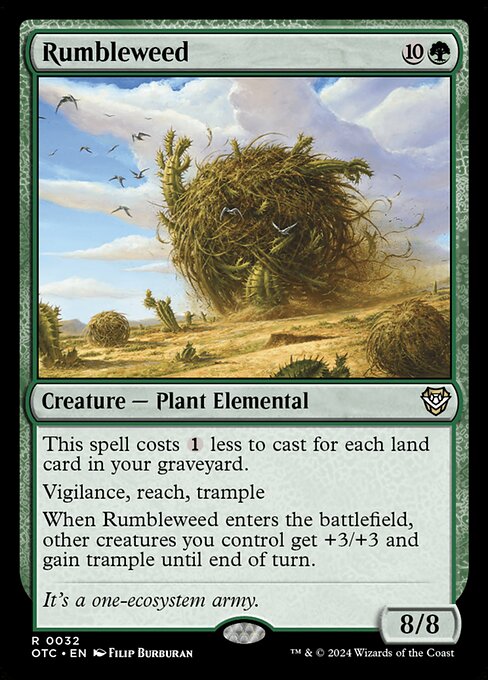
From the Outlaws of Thunder Junction Commander set, Rumbleweed is a rare creature—a Plant Elemental that embodies the grand scale green can reach. With a mana cost of {10}{G} and a powerful 8/8 profile, this locus of growth stands as a testament to green’s big-beast fantasy. Its vigilance, reach, and trample keywords aren’t just flavor; they translate into practical battlefield resilience: it can chip away at problems at multiple angles, protect your board, and deliver a punishing blow when the time is right. The card’s text reinforces green’s hallmark strategy: ramp into a threatening presence and, crucially, leverage the graveyard to bend the cost curve in your favor.
Rumbleweed’s most distinctive mechanic sits in its cost reduction: “This spell costs {1} less to cast for each land card in your graveyard.” That’s a clever engine for green players who lean into land-dense boards or graveyard synergies. It invites you to build around your resources—filling your graveyard with land while accelerating into a colossal threat you can drop for far less than its listed mana cost. In practice, you might glimpse a swingy turn where a handful of lands vanish into the EDH graveyard and suddenly your 11-CMC behemoth becomes a bargain-basement finisher. It’s a delicious paradox: green, the color of growth, sometimes paying the price to become even bigger through memory and mulch 🧙♂️💎.
And then there’s the ETB buff: “When this creature enters, other creatures you control get +3/+3 and gain trample until end of turn.” That’s not just flavor; it’s a tempo and board-advantage tool rolled into one moment. The moment you play Rumbleweed, your board state surges forward—your other creatures surge with extra power and authority, and you drive home with a feisty, multi-pronged attack. It’s green’s version of a battle hymn: a rally cry that can turn a tense stalemate into a winning charge ⚔️🎲.
Traditional vs. Digital: how the art communicates the card’s soul
The original illustration for Rumbleweed, credited to Filip Burburan, is rendered within the 2015 frame style that frames the iconic look of modern MTG creatures. In a traditional sense, you’d expect heavy brushwork, nuanced shading, and a tactile sense of scale—an organic feel that invites you to reach out and touch the leaves, to hear the brush clamp and the rain on vines. Digital approaches, by contrast, can punch up lighting, sharpen micro-details, and layer atmospheric glow that makes the leaves practically shimmer. The balance in Rumbleweed’s art—bold greens, a sweeping silhouette, and a sense of living, breathing growth—feels like a bridge between those two worlds. It’s the kind of image that can be reinterpreted in print, on a tablet, or even on a product case (you’ll see how one crossover product below nods to that kind of cross-media sensibility) 🔥.
“Art that grows with the game is art that stays with you.”
For collectors and players, the visual language matters just as much as the mechanical one. The 8/8 body communicates “heavy hitter” even before you read the card text, and the combination of vigilance, reach, and trample signals that Rumbleweed is designed to press forward despite a potential skyward threat. The color identity is firmly green, matching the set’s ethos of abundance and resilience. The rarity is rare, and the card’s placement in a Commander-focused set reflects how players often seek splashy big-mons with companionships that scale across a board—exactly the scenario where a fully leveled Rumbleweed can turn the tide 🧙♂️🎨.
Pricing, value, and the art of collecting
From a collector’s vantage point, Rumbleweed sits in an approachable tier. Its price on Scryfall reflects a modest market footprint, with USD around 0.47 and EUR around 0.43 for the non-foil print, plus a modest tix value for some formats. The EDHREC rank sits in the broader mid-range, suggesting it’s not a slam-dunk staple, but it does have a place in the minds of green-heavy decks that relish the power spike of an 11-CMC threat or the delight of a board-wide buff that makes your team look like a verdant army of conquest. The art’s enduring appeal—Filip Burburan’s dynamic composition—helps this card keep a place in gallery-worthy binders and in playgroups that love to hash out which green giant will trudge across their table first 🌿💎.
Beyond the table, the dialogue around traditional versus digital art continues to evolve. The physical brushstrokes and ink still carry a tactile memory for veterans of the game, while digital workflows make it easier to explore ambitious, luminous scenes without the prohibitive costs of real-world media. Rumbleweed stands as a practical case study: a card whose visuals lean into the grandeur of a digital-era finish while honoring a traditional painter’s sense for scale, texture, and a narrative impulse that invites players to imagine a world where a single plant can command an entire battlefield 🧙♂️.
Where art, play, and fandom intersect
If you’re chasing the essence of MTG art, Rumbleweed offers a compact snapshot: a creature that embodies green’s flagship themes—growth, resilience, and community—brought to life by a strong, modern illustration under a Commander frame. The card’s narrative—an ecosystem army, fighting on a field where lands in the graveyard can curtail its cost while it buffs the rest of your army—demonstrates why collectors and players alike care about both the image and the mechanics. It’s not just about a big creature; it’s about the story a single card can tell when crafted by a creator who understands the pulse of the Multiverse 🎨⚔️.
As you explore both sides of the illustration coin, consider how your own collection and playstyle reflect the same duality: the romance of a hand-painted texture and the sharp, vibrant finish of a digital composition. And if you’d like to carry a bit of that MTG-inspired energy into everyday gear, there’s a cross-promotional product waiting for curious fans—the sleek iPhone 16 phone case with a glossy Lexan finish. It’s a small crossover, but the vibe stays true: big, bold design meets practical, everyday use. Check it out below and let the aesthetic journey continue 🧙♂️💎.