Image courtesy of Scryfall.com
The Frame as Character: Why Card Borders Evolve with the Game
If you’ve spent any time rifling through MTG card frames, you know the border does more than separate art from rules text. It’s a storytelling device, a tactile cue that says, “What you hold is a modern magic artifact—both familiar and newly dangerous.” The evolution of card frame design tracks the game’s shifting priorities: readability, brand identity, and the delicate balance between nostalgia and innovation. From the early days when a card’s white space fought for every line of flavor text to the contemporary frames that embrace bold silhouettes and digital-ready clarity, Wizards of the Coast has consistently reimagined how a frame communicates power, flavor, and function. 🧙♂️🔥💎
From Borders to Brilliance: the 2015 Frame Refresh
In the mid-2010s, MTG’s visual language received one of its most consequential overhauls: the Frame 2015 update. The redesign sharpened icons, rebalanced the size of the mana cost, tightened the creature type line, and introduced subtler color cues that pop at a glance. The goal wasn’t flashy novelty for novelty’s sake; it was about making gameplay moments easier to parse in fast-paced matches, whether you’re at a kitchen table or streaming a clutch Topdeck moment. The new frame also laid groundwork for future digital adaptations, aligning traditional card art with a screen-friendly presentation that translates smoothly to MTG Arena and other digital formats. 🎨⚔️
With digital-first ecosystems blossoming, the frame began to embrace experimentation without sacrificing recognizability. The standardized layout—name, mana cost, type line, rules text, and flavor text—stays recognizable, but the proportions shift to give cards like this one a sense of weight and presence. The “legendary” tag, already a flavor beacon, gains a more pronounced aura in the frame’s corners, signaling that the bearer carries a unique story in any deck. The net effect is a design language that speaks both to the long-time collectors who treasure the aura of the classic frames and to new players who expect crisp typography and legibility in every draw. 🧙♂️
A Case Study in Digital-First Design: Saint Elenda
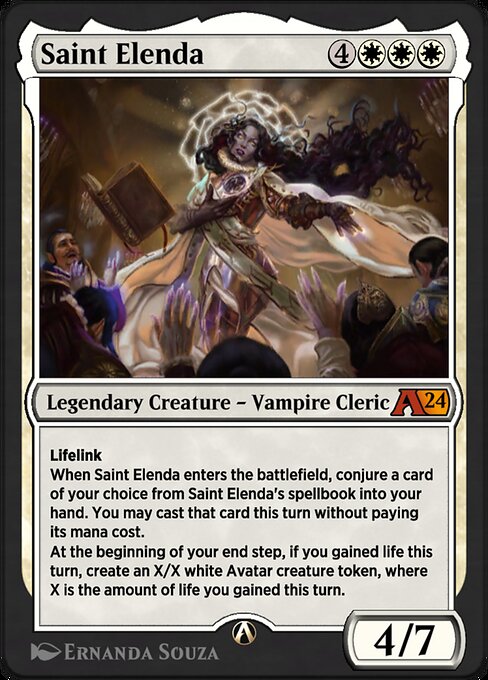
Inside the Alchemy: Outlaws of Thunder Junction set, Saint Elenda stands as a vibrant specimen of how frame design interacts with card mechanics and theme. This digital-only card is a Legendary Creature — Vampire Cleric with a conspicuously modern frame: border color black, frame 2015, and a legendary frame effect that marks it as a focal point in any strategy. Its mana cost of 4WW and a formidable 7 converted mana cost (CMC) push it into the upper echelons of casting anxiety—yet the card’s true magic isn’t merely its stats. Lifelink anchors the board presence, while the Conjure keyword adds a layer of strategic depth that feels tailor-made for Arena’s pacing. 🔥🧙♂️
When Saint Elenda enters the battlefield, you conjure a card from her spellbook into your hand, with the teaser that you may cast that card that turn for free. That “spellbook” conceit is a flavorful nod to the frame’s storytelling potential: the card’s identity isnifies the idea of a living grimoire attached to a single, awe-inspiring body. In the same turn you might chain a spell into play, the end step can reward your choices with an X/X white Avatar token, the size of which scales with life you’ve gained that turn. The text’s elegance—“Lifelink” and “Conjure”—reads crisply against the updated type line and the frame’s carefully balanced space for illustration and text. It’s a microcosm of how the 2015 framework supports complex mechanics in a visually accessible way. ⚔️🎲
“A frame should serve as an ambassador between art and algorithm, guiding your eye from flavor to function without begging for attention.”
The card’s production reality adds another layer to frame evolution discourse. Saint Elenda exists in a digital set with the Alchemy alias, a space where frame and interface expectations diverge from traditional paper product lines. Its rarity is mythic, and its status as a digital print—nonfoil, arena-only—illustrates how design thinking adapts to different distribution channels. The effect is not a regression to simpler times, but a thoughtful expansion of how magic can appear and behave on-screen. The frame flows around a creature whose life-gain mechanic culminates in a tangible battlefield payoff—a token that reflects the health of a match as much as the health of a hero. 🧙♂️💎
How Frame Design Shapes Gameplay and Flavor
There’s a symbiotic relationship between frame design and how you deploy cards. A frame that emphasizes legibility helps you navigate complex stacks of triggers and decisions during a busy turn. For Saint Elenda, the life-gain window and end-step token creation hinge on tracking life totals accurately; a frame that keeps the mana cost and ability text visually accessible ensures that players aren’t stumbling over crucial mechanics when the stakes spike. The inclusion of Conjure, a spellbook mechanic, is particularly telling: it invites players to “season” their own deck with a surprise card from their current hand, blurring the line between library manipulation and spell economy. In the frame’s world, these mechanics are not just rules; they’re a narrative beat about a regal figure commanding a spectrum of possible outcomes at any given moment. 🧭🎨
Another layer worth noting is how Alchemy’s digital-first status influences card presentation. The Alchemy frames encourage experimentation and a bold, modern aesthetic that can accommodate unusual rarities, token generation, and nontraditional spell interactions. Saint Elenda’s life-linked, conjoined mechanics feel at home with a board-swinging tempo that Arena players relish, and the frame’s clarity reduces the cognitive load when evaluating options across a crowded board. This is the frame doing what it does best: acting as a conduit for breathless, exciting play. 🧙♂️
Looking Forward: The Frame as a Living Design Ethos
As MTG continues to blend physical and digital experiences, frame design will likely iterate with new gameplay layers, art directions, and audience expectations. The Saint Elenda example doesn’t just show a pretty border; it embodies a design philosophy where the card’s function, flavor, and collectible appeal are inseparable from how it is seen and understood. Whether you’re chasing a mythic in a newly minted Alchemy set or admiring a classic frame in a curated collection, the border is a companion—an ever-evolving shield and banner for the narratives we cast and the strategies we pursue. 🧙♂️⚔️
- Readability first: Frame refreshes aim to keep rules text legible during rapid, high-stakes plays.
- Digital-friendly design: Arena and other digital platforms drive clarity and contrast, with bold icons and scalable type.
- Flavor through frame: Legendary and frame-effects cues reinforce character and story without fighting the art.
- Collector value: Rarity, digital availability, and unique mechanics (like Conjure) influence how players perceive a card’s desirability.
If you’re building a deck that leverages life gain and dramatic late-game payoff, Saint Elenda offers a compelling case study in how frame design reinforces your strategy. And for those who savor the tactile thrill of the old frames, the ongoing evolution is a reminder that the aesthetics of Magic are as much a part of the game’s charm as the spells themselves. 🧙♂️🎲