Image courtesy of Scryfall.com
Artistic Battles in MTG: Traditional vs Digital
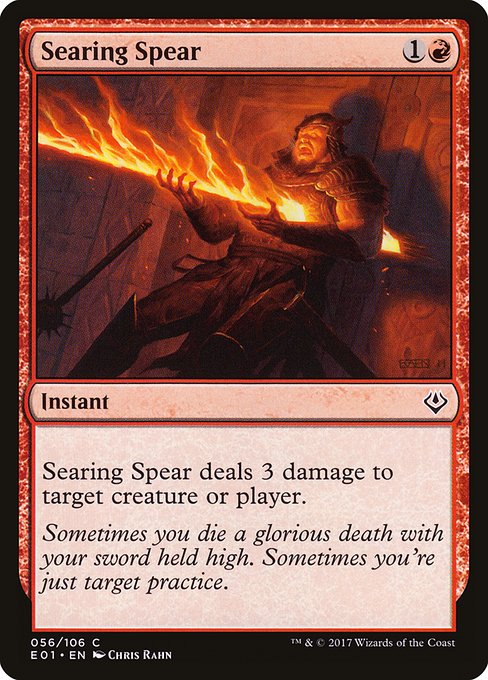
If you’ve ever shuffled a draft deck and marveled at the artwork that accompanies a scorching red instant, you’re already part of the ongoing conversation about how MTG art gets from idea to card. The Searing Spear from Archenemy: Nicol Bolas is a perfect lens for this debate. This common instant—mana cost {1}{R} and a crisp, no-nonsense effect: “Searing Spear deals 3 damage to any target.”—isn’t just about the flame on the blade. It’s about how the artwork communicates velocity, danger, and immediacy in a single frame 🧙🔥⚔️. The color, the linework, and the overall mood all ride on the artist’s brush or tablet, and the choice between traditional and digital workflows shapes both the look and the feel of the card in the player’s mind.
Tradition in Action: What traditional art brings to the table
Traditional illustration has a tactile lineage in MTG’s history. It often emphasizes texture, subtle graduations of color, and a hand-crafted softness that readers can practically feel beneath the surface of the card. In a piece like Searing Spear, you may notice how bold linework and layered paint-like textures can create weight and contrast that push the eye toward the focal moment—hot flame meeting steel with a bright, almost palpable heat. Even without knowing the exact brush strokes, you can sense the craft: edges that soften where light bleeds, shadows that ground the composition, and a sense of physical materiality that invites you to imagine the artist’s studio and the process behind the image 🎨. For fans who grew up admiring classic fantasy art, traditional methods carry a nostalgic gravitas: the glow of a flame, the way metal catches highlights, the imperfect but genuine character of hand-drawn lines.
- Texture and depth: Real-world paint can create organic grain and micro-shadows that feel tactile even on a flat card.
- Atmosphere through pigment: Traditional pieces often lean into richer, more nuanced color transitions that can feel warmer and more “hand-made.”
- Human touch: The small quirks of a brushstroke or pencil line can give a personality to the artwork beyond what a clean digital render might convey.
Digital sensibilities: Speed, precision, and luminous control
Digital illustration has become the engine room for much of MTG’s recent art, and for good reason. With a digital workflow, artists can experiment rapidly, layer lighting effects, and push color grading toward an electrifying pinnacle that feels almost cinematic. In pieces like Searing Spear, the digital path often enables sharper edges where a spear flash might cut through air, and it can deliver a crystalline brightness to the flame that reads well at booster-stamp size and across different printings. The ability to render crisp highlights and radiant glows helps a red spell pop in a crowded battlefield, ensuring the instant looks as explosive in a card screen as it does on a kitchen table during a tournament. Digital also supports broader experimentation with composition, allowing for more dynamic action poses, dramatic lighting angles, and a quicker realization of a card’s thematic punch 💎🎲.
- Consistency across print runs: Digital pipelines make color matching and line consistency reliable across reprints and sets.
- Lighting control: Cyber-like glow, ember halos, and flame shards can be tuned with precision to maximize readability at different sizes.
- Rapid iteration: Artists can refine a piece quickly, testing mood and tension before finalizing a design.
Analyzing Searing Spear’s artwork within its universe
Chris Rahn’s illustration—per the card’s lore and its place in the Archenemy: Nicol Bolas set—conveys a moment of decisive, almost ritual violence. The spear, a simple but devastating weapon, becomes a conduit for the spell’s raw tempo: a fast, direct strike that ends a turn or shatters an opponent’s plans. The flavor text—“Sometimes you die a glorious death with your sword held high. Sometimes you're just target practice.”—embeds a narrative attitude into the art: glory and danger ride side by side, a reminder that in the world of MTG, every action is a narrative beat. Whether executed with traditional brushwork or modern digital tools, the design taps into a classic fantasy-epic cadence—the kind that makes you pause, feel heat on your face, and think, “If I cast this, I’m in for a quick, fiery moment of truth 🔥⚔️.”
Sometimes you die a glorious death with your sword held high. Sometimes you're just target practice.
Format, rarity, and what the art choice means for collectors
In the card’s ecosystem, Searing Spear sits as a common nonfoil from the Archenemy: Nicol Bolas release in 2017. That makes it accessible and familiar to players who build budget-friendly red midrange or burn-focused decks in Modern, Legacy, or other formats where the card remains legal. The artwork’s impact, however, isn’t limited to playability; it influences how collectors perceive a printing. A common card with striking art can feel iconic if the image resonates with the community—the army of players who collect sets, chase foils, and debate the finest variations of color and composition. Rahn’s piece, with its bold red energy and aggressive stance, tends to become a fan-favorite in discussions about set design and the evolution of MTG’s visual language.
Beyond sheer aesthetics, reprints and set design choices shape a card’s life in the wild. Archenemy sets, designed around a dramatic, antagonist-forward fiction, cultivate a bold, cinematic art direction. Searing Spear’s immediate readability—3 damage to any target—pairs nicely with a visually dynamic frame that can hold its own in a sleeve-backlit display or on a social media scroll. This synergy between gameplay clarity and eye-catching art is at the heart of MTG’s ongoing art-to-game conversation 👀🎨.
Practical tips for players and artists alike
For players, the takeaway is simple: a clean, high-contrast image helps you identify your targets quickly, especially in fast-paced games. For artists, the challenge is choosing a path—traditional or digital—that best serves the card’s personality and the set’s mood. The Searing Spear artwork demonstrates how a straightforward spell can become a cultural touchstone when paired with a compelling composition and a strong color story. If you’re collecting or studying MTG art, compare different printings of the same card across sets to observe how lighting, saturation, and edge treatment shift with the medium. And if you’re building a wall of MTG art at home, owning a print or a faithful reproduction of Rahn’s piece can be a delightfully tactile way to celebrate the tradition of fantasy illustration 🧙🔥🧩.
Where art, play, and culture collide
The intersection of traditional and digital art in MTG is more than a technical debate; it’s a celebration of how imagery shapes play culture. A vibrant, flame-swept spear can spark a moment of memory—the first time you saw a card you loved, the thrill of a well-timed burn spell, or the realization that a single frame can carry a story across years and formats. This is the magic of MTG art: it ages with you, adapting to new printing technologies while preserving the lore, the glories, and the playful chaos that make this multiverse so irresistible 🧙🔥💎⚔️.
Quick card snapshot
- Name: Searing Spear
- Mana cost: {1}{R}
- Type: Instant
- Rarity: Common
- Set: Archenemy: Nicol Bolas (e01)
- Artist: Chris Rahn
- Flavor text: Sometimes you die a glorious death with your sword held high. Sometimes you're just target practice.
- Text: Searing Spear deals 3 damage to any target.
- Legal formats: Modern, Legacy, Pauper, Vintage, Commander, and more in various printings; this specific reprint is widely accessible in nonfoil form.
As you curate your collection or design your own Kakashi-style swing through a tournament table, remember: the art you admire on a card is more than decoration. It’s a window into the artist’s process, a reflection of the era’s flavor design, and a reminder that even a small burst of flame can carry a world of meaning. If you’re looking to level up your desk for long sessions of table gaming, consider a gaming accessory that respects the spirit of the art you cherish—something like the Neon Gaming Mouse Pad 9x7 with customizable neoprene alongside stitch-edged durability. It’s a practical nod to the aesthetic you love, letting you focus on the game while your setup glows in the same red-hot tones that inspired this card’s art sense 🧙🔥🎲.
To explore the product that pairs nicely with your MTG hobby setup—and to support the projects that keep these worlds thriving—check out this neon mouse pad: Neon Gaming Mouse Pad 9x7 Customizable Neoprene Stitch Edges. It’s a small way to celebrate the hobby while you draft, race the clock, and trade stories with fellow planeswalkers.