Image courtesy of Scryfall.com
Silver border symbolism in parody sets
Magic: The Gathering has a long love affair with borders as a storytelling device. When we glimpse a card with a silver, gold, or even no border at all, we’re not just looking at aesthetics—we’re reading a wink from the design team. Silver borders, in particular, have historically marked nonstandard formats, joke sets, and experimental gameplay. They signal that what you’re about to read or play with isn’t part of the regular ruleset, but something the community can savor for flavor and fun 🧙♂️🔥💎. In parody or “funny” sets, that border acts like a magician’s cue: prepare for something wild, unexpected, and delightfully imperfect. This article focuses on how those signals show up in a card like The Food Court, a Planar piece set in the Eldraine-inspired oddball universe known as Unknown Event, and what it reveals about the broader design philosophy behind parody MTG sets 🎨🎲.
The Food Court: a case study in parody design
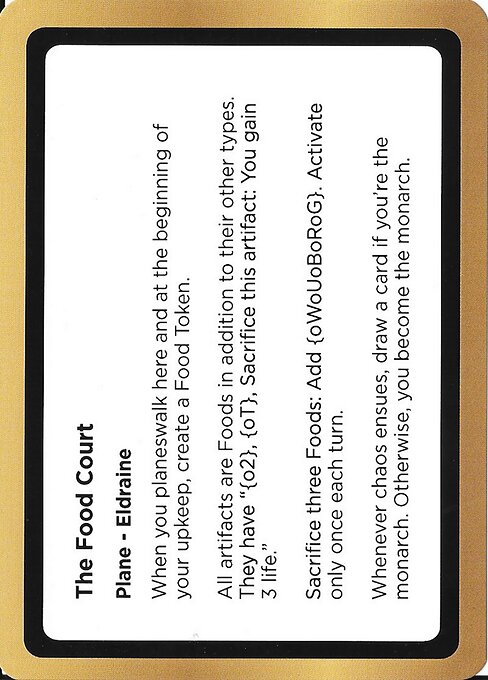
From a lore and gameplay perspective, The Food Court sits at an intriguing crossroads. Classified as a Plane — Eldraine card, it arrives in an oversized, nonfoil, gold-bordered frame within a funny, tongue-in-cheek set called Unknown Event. The card’s mana cost is zero, a rarity not often seen on the battlefield, and its type line—Plane — Eldraine—places it squarely in the realm of worldbuilding rather than conventional creature or enchantment stacking. The flavor of Eldraine—a feasting court full of whimsy and whim—meets a modern, kitchen-sink approach to artifacts: here, artifacts are redefined as Foods in addition to their other types. That single line unlocks a cascade of thematic possibilities, from life-gain loops to five-color mana ramps that feel more like a party trick than a tournament plan 🧙♂️🍽️.
Oracle text: Artifacts are Foods in addition to their other types (They have "{2}, {T}, Sacrifice this artifact: You gain 3 life.") Sacrifice three Foods: Add {W}{U}{B}{R}{G}. Activate only once each turn and only during your turn. Chaos: You become the Monarch. If you are already the Monarch, draw a card.
That oracle text reads like a playground for ideas. The first clause makes every artifact a potential Food, inviting the player to accumulate and curate a buffet of value that doubles as a ramp engine and a life buffer. The second clause—Sacrifice three Foods: Add one of each color—turns your midgame board into a five-color windfall, a neat nod to the five-gear wheel of MTG’s color pie 🧙♂️💎. The constraint—activate only once per turn and only on your turn—keeps it from spiraling out of control, while the Chaos ability to become the Monarch adds a light, political twist that mirrors the courtly chaos Eldraine is famous for ⚔️🎭. It’s a delicate balance: label something as a silly novelty, and you open the door to genuinely creative, even broken, interactions—yet the card’s common rarity and playful framing ensure it remains approachable for casual tables and kitchen-table legends alike 🔥🎲.
Border, flavor, and gameplay alignment
The Food Court’s card border—gold in this case—speaks to its status as a novelty print rather than a standard-issue staple. In parody and experimental sets, border choice becomes part of the narrative. Silver borders are often invoked to evoke a sense of “this is not normal MTG,” while gold borders in Unknown Event communicate a different flavor: a humorous, celebratory, and slightly over-the-top experience. The card’s Planar Eldraine heritage merges with a set type labeled “funny,” reinforcing that the journey here is as much about storytelling as it is about winning on the battlefield 💫. For players who enjoy the lore-adjacent pleasure of “what if” scenarios, The Food Court is a tidy illustration of how border symbolism can guide expectations and encourage experimental deckbuilding 🧭.
Strategy notes for the curious crafter
In any discussion of parody cards, the real joy is imagining how these pieces would function in a casual or brew-heavy environment. The Food Court invites you to experiment with Food token synergies and life-gain triggers. A deck built around this card could leverage Foods as both fodder and fuel—sacrificing three Foods for a five-color mana infusion can unlock explosive turns when you’re ahead on the Monarch track or when you’ve already established board presence. The Monarch mechanic, granted by Chaos, adds a political edge: drawing a card when you’ve achieved the crown can feel like finally collecting the king’s treasure after a long, delicious feast. It’s a playful reminder that in parody sets, the journey matters just as much as the destination 🧙♂️🃏.
- Flavor-forward builds: Lean into Eldraine’s courtly vibes and the Foods-as-artifacts concept to create a themed board state where feeding the table becomes a form of mana acceleration.
- Win conditions: Don’t rely on raw power alone—play into the Monarch triggers and the life-gain engine to outpace opponents who may laugh at your oddball strategies but can’t resist your culinary charisma ⚔️.
- Casual viability: As a common, nonfoil, oversized card from a parody set, The Food Court shines in commander pods and casual games where flavorful, clever plays are prized above pure tempo.
Even if your local store doesn’t regularly run Unknown Event drafts, this card is a sparkling reminder of MTG’s broader universe—the way a border color, a playful rule interaction, and a wild flavor text can transform a card from “just another artifact” into a memorable experience. It’s the sort of piece that makes you grin at the table, reach for your sleeve to adjust a sleeve-torn life ledger, and dare your friends to outcook the board with a better play. And if you’re collecting or curating a shelf that celebrates MTG as both game and story, The Food Court earns its seat at the feast 🧙♂️🔥🎨.
While you chase victory in the five-color chaos, you might also chase practical gear for your gaming life. A reliable phone case can keep your tech safe during long gaming sessions, events, or casual play days—hence this neat cross-promo below. It’s the kind of everyday accessory that quietly supports your hobby, letting you focus on drafting, trading, and storytelling without worrying about the spill of a lemonade or a spill of glitter from a tabletop mishap.