Image courtesy of Scryfall.com
Magic: The Gathering has always thrived on cultural shorthand—dance, folklore, and theatre aren’t just flavor text; they’re a vocabulary you can read in a single card. When a set leans into vampire lore and ballroom drama, the humor lands in a way that’s both knowing and celebratory. Sinister Waltz, a rare from Crimson Vow Commander, stands as a prime example. Its bold pairing of black and red mana cost, its dramatic flavor, and its playful but purposeful mechanics invite you to think about how culture, storytelling, and card design echo through the multiverse 🧙♂️🔥💎⚔️🎨🎲.
The dance as symbol: ballroom grandeur meets vampiric culture
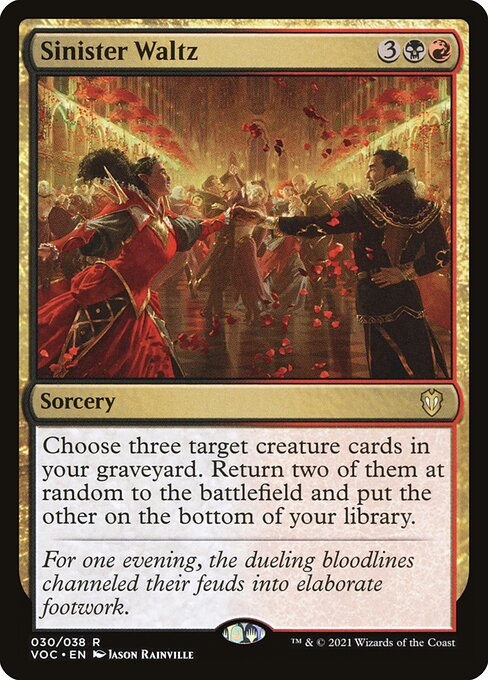
The very title of this spell—let’s not confuse it with a dance lesson—evokes a ballroom where aristocratic feuds are settled not with violence alone, but with ritualized performance. The artwork by Jason Rainville captures a moment of poised, deadly elegance, a waltz that hints at centuries of vampire dynasties colliding in a single, moonlit night. In many MTG humor cards, players glimpse a cultural symbol and a wink at how communities perceive power: dance becomes diplomacy, a well-choreographed step can hide a lethal intention, and fashion is a battleground as much as the board. This is the humor’s backbone: it respects the lore while gently ribbing the ritual precision of those who love to stage their own feuds in style 🧛♀️✨.
Mechanics as metaphor: fate, chance, and the ritual return
Sinister Waltz costs {3}{B}{R} and is a five-mana sorcery from the Crimson Vow Commander set. Its oracle text asks you to “Choose three target creature cards in your graveyard. Return two of them at random to the battlefield and put the other on the bottom of your library.” On the surface, this is graveyard recursion—a mechanic many players adore for its resilience and inevitability. Metaphorically, the random return feels like fate presiding over a family feud: sometimes the most brutal relatives reappear to assert themselves; sometimes a hinge-turning ally lands where you least expect it. The randomness mirrors the theatrical unpredictability of a waltz—graceful and controlled, yet punctuated by sudden shifts that require you to improvise on the fly 🌀🎭.
“For one evening, the dueling bloodlines channeled their feuds into elaborate footwork.”
That flavor text isn’t just mood; it grounds the card in a cultural moment where lineage, honor, and spectacle collide. The line reinforces the idea that within vampire lore—and within MTG’s broader mythos—stories are told through performance as much as through violence. Humor cards often wink at these heavy traditions, reminding us that even the most blood-soaked fantasy can have a ballroom gentleness at its core. Sinister Waltz uses this duality to invite a smile from veteran players while rewarding strategic play for those who lean into graveyard synergies and chaotic outcomes ⚰️💃.
Aesthetic and lore in harmony: art, flavor, and design choices
Rainville’s illustration leans into the elegance of a waltz with a dark, Gothic edge that resonates with Crimson Vow’s overarching vampire theme. The black border, classic frame, and the oval security stamp all communicate a sense of timeless ritual—yet the creature cards in your graveyard becoming players again at random adds a fresh twist to this dance. The card’s rarity (rare) and its accessible mana cost-friendly design make it a tempting include for EDH players who want to surprise opponents with a late-game swing. It’s a reminder that MTG humor cards aren’t just jokes; they’re cultural artifacts that blend art, lore, and clever game mechanics into a single, memorable moment 🎨🩸.
The humor card as cultural commentary within MTG’s tapestry
Humor cards in MTG often function as a cultural lens: they comment on in-jokes, tropes, or shared player experiences. Sinister Waltz doesn’t punchline you with a meme—it skewers the romance-and-rivalry narrative of vampire houses by packaging it in a ceremonial spell. The “waltz” implies choreography and etiquette; the “sinister” qualifier signals that the dance has a dark side. This duality mirrors how fans parse vampire fiction and fantasy storytelling: you thrill at the spectacle, even as you’re reminded of the cost of power and succession. The result is a card that feels witty without breaking immersion—a balancing act that many of MTG’s most beloved humor cards aim to achieve 🧙♂️⚔️.
Play patterns, Commander culture, and collector value
In Commander circles, Sinister Waltz shines because it can resurrect up to two creature cards from your graveyard in a single turn—though you must accept that one of the trio will end up at the bottom of your library. It invites you to build around graveyard synergies, fuel politics at the table, and craft moments where fate, luck, and strategy collide with dramatic flair. The card’s color pairing—black and red—lets you weave removal, reanimation, and chaotic board presence into a single, wickedly satisfying package. While its market price sits in an accessible range for casual players, its true value lies in the stories and memories it helps generate during long evenings of tabletop play — a cultural artifact that ages with the player community 🧯🧩.
Collector’s note and cross-promotional moment
Crimson Vow Commander marks a chapter where MTG’s lore-rich vampires got to strut their stuff with humor and heart. If you’re looking to capture more moments of tabletop culture beyond the battlefield, consider equipping your gear with a rugged, dependable case—perfect for ferrying decks, play mats, and pocket notes between rounds. The product below blends practical protection with a dash of style, so your waltz from table to table stays smooth and stylish.