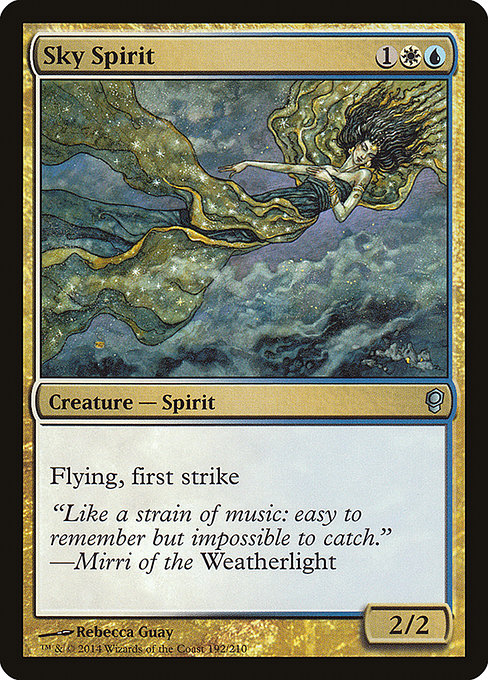
Image courtesy of Scryfall.com
Regional Trends in Sky Spirit Collecting
Magic: The Gathering has always rewarded the patient, the curious, and the border-hopper who watches markets as closely as mana curves. When you pair a quirky, two-colored creature like Sky Spirit with a global hobby that spans everything from casual EDH kitchens to high-stakes eBay auctions, you get a fascinating canvas of regional price disparities and collector behavior 🧙🔥💎⚔️. Sky Spirit, a blue-white draft-friendly creature from the Conspiracy set, sits in a curious spot: not the flashiest uncommon, but a card that reflects how supply, demand, and geography shape value in real time.
Sky Spirit comes with a clean arithmetic of mana and tempo: a 3-drop 2/2 with flying and first strike. That combination—evade-heavy pressure backed by precise trades—made it a friend to tempo players in older formats and a nostalgia anchor for collectors who remember the Conspiracy draft environment. The card’s dual-color identity (U/W) makes it especially reactive to cross-border price drift: where blue-white staples are easy to find in one region, foil printings or certain print runs can be scarcer in another. The net effect is a price mosaic that often tells a story about supply lines, shipping costs, and collector psychology as much as it tells a story about the card’s text box.
“Like a strain of music: easy to remember but impossible to catch.” — Mirri of the Weatherlight
That flavor line isn’t just flavor—it mirrors the collector mindset: the chase for that perfect foiled copy or the right condition at the right time. Sky Spirit is uncommon across the CNS print, and like many Conspiracy cards, it has seen reprints that flatten some price volatility while enabling new regional markets to emerge. The card’s history is a reminder that rarity labels don’t tell the full tale of value; regional plays, foil availability, and currency shifts do 🧭🎨.
Price snapshot by region
- USD (non-foil): around $0.15 for most copies, with foil versions climbing higher as collectors chase the luster and rarity of foil stock. Foil copies can crest into a few dollars in markets with strong foil culture or where supply is more constrained.
- USD (foil): approximately $3.47, a reflection of foil premium and the card’s appeal to foil collectors who prize shimmer and edge-to-edge detail in Rebecca Guay’s artwork.
- EUR (non-foil): roughly €0.11, illustrating how European markets can diverge from North American pricing for older or less-demanded commons and uncommons.
- EUR (foil): around €1.15, showing foil demand persists across currencies, though it doesn’t always translate into similar absolute values as USD.
- General market note: The CNS set’s “draft_innovation” framing affects spiky demand around regional events. In places with active casual play, Sky Spirit often sits in tempo decks; in regions with strong Legacy or Commander communities, it becomes a valued foil or a nice pickup for a budget deck with a pop of air and first strike.
What drives the regional gaps?
- Logistics and access: Some regions have vibrant local game stores with frequent stock refreshes, while others rely on international imports. Shipping times and duties can turn a low-listed uncommon into a price swing factor.
- Currency and tax dynamics: Exchange rates and VAT can tilt the real-cost of a foil Sky Spirit for local buyers, creating price anchors that differ from U.S. market averages.
- Foil and non-foil supply: Foil copies tend to be scarcer in certain regions due to distribution patterns, which pushes legitimate buyers toward online marketplaces where prices normalize around demand, not proximity.
- The reprint effect: CNS cards that were reprinted or redistributed in later sets tend to soften price volatility in some markets while preserving upside in others where supply is tighter.
Collector behavior patterns worth watching
- Regional price chasing: Collectors in price-sensitive regions often gravitate toward near-mint non-foil copies for playability and budget value, while foil enthusiasts chase that radiant edge-case card stock for display and prestige 🧙🔥.
- Cross-border buying and selling: Savvy buyers monitor price signals across currencies and marketplaces, leveraging transient gaps caused by regional promotions, local conventions, or stacking shipping costs to optimize overall expenditure.
- Condition and grading bias: In modern times, collectors increasingly weigh card condition against regional price drift. A pristine Sky Spirit in a favorable light exposure can command a disproportionate premium in some markets, while others value functional gameplay copies more highly.
- Aurora of nostalgia: The Conspiracy era is remembered fondly by a generation that built its childhood around draft boxes, sealed events, and the Weatherlight’s enduring lore. This nostalgia often translates into a willingness to pay for a foil version as a badge of collector identity, even when playbacks are available in cheaper nonfoil forms.
Gameplay angles that influence collector interest
Beyond the financial beat, Sky Spirit offers meaningful tempo in any blue-white shell. Its flying, first strike combination allows for precise trades against red aggressive decks or weak-flying blockers, turning a single card into a cornerstone of a midrange tempo plan. In Commander formats, where identification and versatility trump sheer punch, Sky Spirit can slot into several two-color commanders that lean on evasive fliers or control lines. The 2/2 body for three mana is not a powerhouse on a spreadsheet, but in a table full of politics and board stalls, it’s a steady contributor to board presence and race dynamics ⚔️🎲.
The card’s flavor, artistry, and framework in Conspiracy also matter to collectors. Rebecca Guay’s evocative illustration—paired with the flavor text that nods to Mirri of the Weatherlight—gives Sky Spirit more than a stat line: it gifts it a story, a vibe, and a place on the wall of a well-loved binder. That narrative lift is often enough to justify a foil upgrade for a subset of players who prize art as part of the glass-bead balance of a modern MTG collection 🎨.
Practical takeaways for collectors and players
- Track foil and non-foil price vectors separately; the foil channel often leads to higher regional premiums, even when non-foil prices trend downward.
- Monitor currency shifts and shipping options in your region. Small changes in logistics can yield big savings for a card that’s budget-friendly but keeps a premium foil footprint.
- Use Sky Spirit as a gauge for your next trade or buylist target. In Legacy and Commander circles, two-color blue-white spells decks are a familiar home; a well-priced Sky Spirit can be a gateway card to more ambitious strategic buys.
- Consider the collectible-path approach: if you’re drawn to the artwork, a foil copy can serve as a centerpiece in a display or a conversation starter at a casual table—creating value that isn’t purely financial.
If you’re a gamer who loves the vibe of tabletop strategy and the tactile joy of a well-crafted desk setup, you might enjoy bridging those worlds with practical gear that keeps your MTG obsession front and center. A meticulously designed desk mouse pad can be the perfect companion to your Sky Spirit adventures—combining utility with a touch of fantasy flair that mirrors the card’s own aura. Have a look at this customizable desk mouse pad, a product that makes your play space as thoughtful as your deck 🧙🔥💎.
Ready to upgrade your desk and your binders at once? Check out the product below and bring a touch of Conspiracy-era charm to your daily grind. The synergy between a well-curated collection and a well-made accessory is real—your future self will thank you during long drafting sessions and late-night brew-ups of brew and board ⚔️🎲.