Image courtesy of Scryfall.com
Community contests and themed decks: how Stab Wound sparks creative play
Magic: The Gathering thrives on the stories the players tell as they build, brew, and battle their way through crowded tables at local game nights or sprawling online tournaments. When a community hosts a contest around a single card, the frame tightens around a specific flavor and mechanical space, inviting inventive interpretations. In the case of a black aura like Stab Wound, fans lean into the tension between control, tempo, and subtle life-drain strategies. The result isn’t just a decklist; it’s a story about how a single enchantment can tilt the balance between aggression and restraint 🧙♂️🔥.
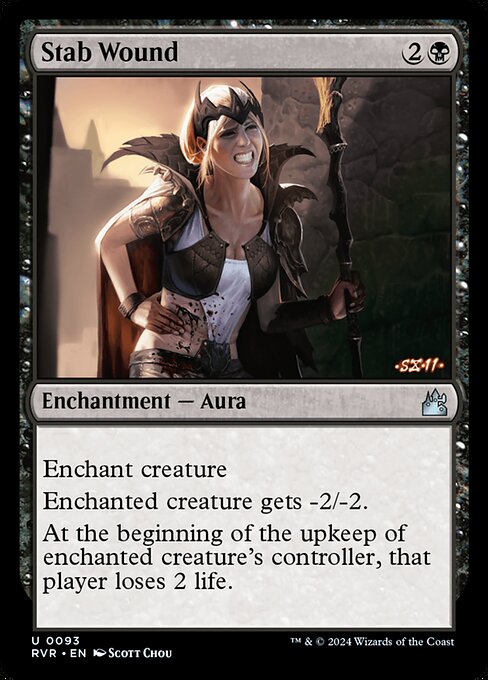
Stab Wound is an enchantment — aura from the black mana color identity, with a modest mana cost of 2 and one black. Its text is to enchant a creature, giving that creature -2/-2, and then, at the beginning of the upkeep of the enchanted creature’s controller, that player loses 2 life. It’s the kind of card that shines in a contest where players explore the psychology of threat assessment: do you protect the aura and your own life total, or do you weaponize it to pressure your opponent’s board by forcing them into awkward, high-stake decisions every upkeep? The aura’s simplicity is deceptive; it creates a quiet clock on the battlefield and invites clever shuffles, stalling tools, and timing tricks that contest organizers love to reward 🧭⚔️.
Why community-driven themes love Stab Wound
First and foremost, the card’s negative aura mechanic prompts players to think about “what do I enchant?” rather than “what do I cast?” That invites thematic decks around sabotage, misdirection, and calculated doom. In a Ravnica Remastered environment—an evergreen Masters-style release that reintroduces beloved cards from the famous city-plane—Stab Wound sits comfortably at the crossroads of the Golgari-black rhythm and Dimir’s shadowy manipulation. It’s not flashy in the way a bomb rare is, but in a community setting, it rewards careful consideration of tempo, resource management, and how you can turn a single enchantment into a narrative arc over the course of the game 🔮🧪.
It’s also worth noting the card’s artistic and collector appeal. Crafted by Scott Chou and printed as an uncommon in Ravnica Remastered, Stab Wound taps into a classic flavor: a sly, blade-edge enchantment that tethers a creature to a fate of attrition. The interplay between the aura and the creature’s controller’s life total becomes a talking point for themed builds, art appreciation, and even casual lore speculation among fans who enjoy connecting the dots between card flavor and community storytelling 🎨💎.
Deck-building prompts inspired by a contest around a single aura
- Saboteur black control — Target creatures you don’t control with Stab Wound and use beefy removal and stalling strategies to keep the battlefield fragile for your opponent. The upkeep life loss adds a ticking clock that nudges players toward decisive finishes rather than slow, drawn-out grind corridors 🧙♂️.
- Opponent-focused tempo — Craft a deck that emphasizes forcing your opponent into awkward decisions on upkeep. When Stab Wound is attached to an opposing creature, every upkeep becomes a mini-turning point where they must decide whether to pay life or risk losing more of their board leverage.
- Reattachment and resilience — Since enchantments can be fragile, contestants often layer in mechanics that can reattach or re-resolve Stab Wound to keep the pressure up. Think about strategies that protect enchantments, or ways to sneak in fresh copies if the aura is silenced or bounced off the battlefield.
- Budget elegance — The card’s uncommon status makes it accessible to a broad audience. Themed contests can reward elegant, low-cost shells that demonstrate powerful intention with limited resources—an invitation to players who love clever synergy more than expensive staples 🪄.
Sample arc ideas you’ll see in community showcases
In many community showcases, you’ll spot a few recurring arcs. The “clockwork opponent” theme uses Stab Wound to push a will-they-or-won’t-they scenario where the enchanted creature’s controller must weigh the risk of losing life against the threat of a more ominous board state. Another popular path is the stealthy sabotage concept: entangle your aura with other forms of disruption, forcing your opponent to answer multiple pressures at once. A third path emphasizes lore and flavor—the idea that a dark spell can tip the balance of a guild conflict in a moment of quiet, unseen menace. Each arc is a tribute to the power of a simple aura to tell a big story on tabletop 🧙♂️🔥.
Maintaining balance between flavor and function
A strong themed deck is one that remains playable beyond the contest’s novelty. Builders should focus on maintaining a robust mana base, reliable ways to interact with enemy threats, and resilient strategies to survive early pressure while the Stab Wound clock ticks down. The inclusion of related pieces, like Perforator Crocodile (a creature card connected in the same design space), offers opportunities for synergy without crowding the primary plan. Keeping the board state dynamic—deploying threats, applying the aura, then folding into a win via consistent card advantage—ensures your theme stays fun and competitive 🎲.
“In a community-driven meta, the best decks aren’t always the most powerful on paper; they’re the ones that tell a story at the table and invite others to join the narrative.”
The beauty of contests centered around a card like Stab Wound is how it democratizes deck design. It invites players to translate flavor into function, to experiment with tempo and life totals, and to share the journey with friends old and new. It’s a reminder that MTG’s magic often lies not in the biggest creatures or flashiest combos, but in the conversations and design philosophies that bloom when the community comes together to brew around a shared spark 🧙♂️🔥💎.
For broader inspiration and to see a few related ideas in practice, you can explore community articles and deck showcases that reference Stab Wound and its kin from Ravnica Remastered. The set’s timeless black identity pairs nicely with explorations of control, attrition, and subversive board presence. If you’re collecting or trading, the card’s uncommon status keeps it approachable for casual players, while foil versions add a touch of prestige to any sleeve collection 🎨.