Image courtesy of Scryfall.com
Reprint Economics in MTG: A Case Study Inspired by Survive the Night
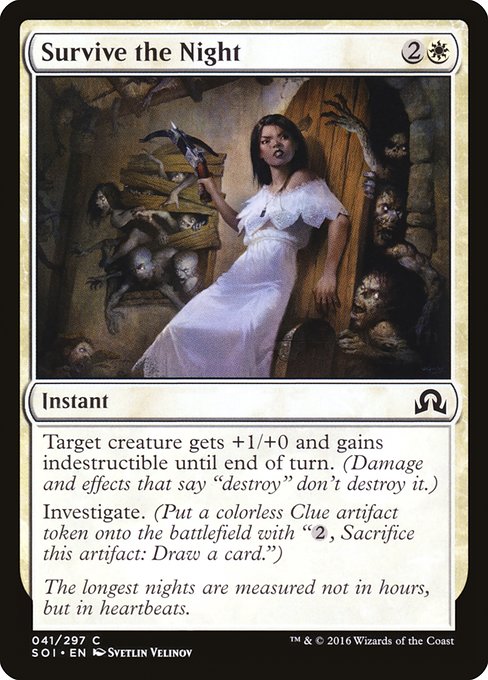
Magic: The Gathering thrives on an intricate dance of supply, demand, and timing. Every new set, every reprint, every variant reshapes the market for cards big and small. Today we lean into the lifecycle of reprints through a practical lens, using a common-white instant from Shadows over Innistrad as our guide. Survive the Night — a tightly scoped spell with a lot of flavor and a surprisingly sharp edge in the right moments — provides a microcosm of how rarity, utility, and print history influence a card’s value over years. 🧙♂️🔥
Survive the Night is a classic example of a White instant that wears two hats at once: it buffets a creature just long enough to weather a swing, and it generates value in the form of a Clue token via Investigate. The card costs 2W, spells out “Target creature gets +1/+0 and gains indestructible until end of turn,” and then grants you a Clue token. In terms of MTG economy, that pairing of immediate board impact with a built-in card draw engine is a durable blueprint for a staple-ish common. Its rarity — common in the Shadows over Innistrad set — ensures wide availability, a steady baseline supply, and modest price points, even before we consider reprint dynamics. The flavor text, “The longest nights are measured not in hours, but in heartbeats,” hums with tension and fits the set’s gothic mood, reminding players that even a small spell can swing an encounter when timing meets opportunity. ⚔️
From an economic perspective, the lifecycle of a reprint hinges on three signals: rarity and baseline supply, demand driven by deck archetypes, and the cadence of reprint opportunities. Survive the Night sits in white’s toolbox as a flexible tempo play. Because it’s a common with a straightforward effect and a synergistic Investigate trigger (which itself commonly creates Clue tokens that can fuel future plays or card draw), it has intrinsic utility for limited formats and some constructed environments. That utility, in the absence of a reprint, tends to keep prices anchored in the sub-dollar range. On Scryfall’s data snapshot, you’ll see non-foil around $0.05 and foil around $0.20, which is emblematic of many commons that see light in multiple sets but don’t command premium scarcity. The market treats it as a staple rather than a chase — a stable baseline that reprints can either reinforce or erode, depending on the broader print strategy. 💎
Reprints act as economic pressure valves. When Wizards of the Coast identifies a card as a potential reprint candidate, two forces typically emerge: a temporary price dip due to increased supply and a longer-term structural risk if the card suddenly becomes widely available in a newly accessible format or altered rarity tier. For a common like Survive the Night, a targeted reprint in a future supplemental set or a Masters-style product would likely amplify supply even further, pulling the average price downward and potentially narrowing the range of foil premiums. Yet the same card could find renewed resonance in a new Commander deck or a modernized white tempo shell, providing a fresh spike in demand for a period before returning to the mean. The lifecycle is rarely linear; it’s a waveform shaped by meta shifts, collectible interest, and the economics of printing logistics. 🧙♂️🎲
“In the long arc of MTG’s history, reprints are less about killing value and more about redistributing it, often rewarding players who recognize when a card’s utility outlives a single season.”
Let’s talk about the practical implications for players and collectors. For players, Survive the Night remains a versatile play at the 3-mana mark that can turn a favorable attack into a win-by-one scenario or stabilize a board against an aggressive onslaught. Its indestructibility lasts just long enough to ride out a key swing, after which you’re left with a Clue token that can be converted into a card draw later on. In terms of deck construction, that balance of tempo and value makes it a reasonable inclusion in white commanders, midrange, or control shells that want to leverage “Investigate” synergy without overloading on rimcard dust. The dual utility of protection plus token-era card draw aligns nicely with the way reprints modulate supply curves: steady, not flashy, but enough depth to remain viable even as formats shift. And if you’re a collector, the card’s foil presence and nonfoil baseline offer a low-cost entry point for a collectible staple that doesn’t demand a casino-sized budget. ⚔️
From a lore and art perspective, the Shadows over Innistrad line carries a mood that resonates with players who cut their teeth on the gothic horror era of Magic. The art by Svetlin Velinov evokes both dread and resolve, a reminder that even a brief, white-laced spell can alter outcomes in meaningful ways. The story behind the set — and the broader arc of Innistrad’s haunted world — adds cultural texture to the card’s value proposition, turning it into more than just an edge case in a pricing chart. The lifecycle lens invites fans to appreciate how a card’s identity and community meaning interact with its monetary value, an alchemy that keeps MTG vibrant and collectible. 🧙♂️💎
Practical takeaways for the market
- Baseline value matters. Commons with stable utility tend to hold, then drift, as reprint calendars fill gaps. Survive the Night’s current price points reflect a durable, if modest, value ceiling. 🔥
- Foil premiums are sensitive. Foil versions fetch higher prices, but reprints can compress the premium unless the foil print is tied to a special edition or a unique print run. 💎
- Format dynamics drive demand. Commander and modern legalities offer ongoing visibility; reprints in those spaces tend to shift pricing trajectories more than standard-only printings. 🧭
- Investment alongside play. If you’re a player-investor, monitor set schedules and potential reprint rumors; a sudden announcement can pull the rug and then slowly recover as players seek out affordable playables again. 🧙♂️
- Story and art affect collectability. Flavor and artwork deepen attachment, which can cushion price volatility during reprint waves. 🎨
Speaking of cross-promotion and community value, if you’re in the mood to level up practical MTG discussion and enjoy clever merch crossovers, our partners at a quirky shop offer a different kind of daily-use gadget — a friendly nudge that tech-savvy players appreciate. Imagine pairing a well-timed Survive the Night with a reliable everyday carry, a concept that winks at the economics of scarcity and utility alike. For those who love the mechanical side as much as the lore, it’s a playful reminder that MTG economics isn’t only about price tags—it’s about how cards, players, and stories weave together across years and formats. 🧙♂️🎲
Ready to explore more from the network and see a broader spectrum of MTG conversation? Check out these deep dives from trusted sources, and then come back to discuss how reprint cycles have shaped your own collection strategy.
Clear Silicone Phone Case Slim Durable Open Port DesignMore from our network
- https://blog.digital-vault.xyz/blog/post/best-boros-recruit-commander-pairings-to-maximize-its-effect/
- https://blog.digital-vault.xyz/blog/post/skull-catapults-recurring-characters-in-mtg-lore/
- https://blog.digital-vault.xyz/blog/post/luminous-blue-giant-inferred-luminosity-from-photometric-magnitudes-at-7800-light-years/
- https://transparent-paper.shop/blog/post/unlocking-creative-expression-with-digital-paper-for-journaling-communities/
- https://blog.digital-vault.xyz/blog/post/nostalgia-sparks-a-bond-with-gale-conduit-of-the-arcane/