Image courtesy of Scryfall.com
Talion, the Kindly Lord: Allies and Rivals in MTG Lore
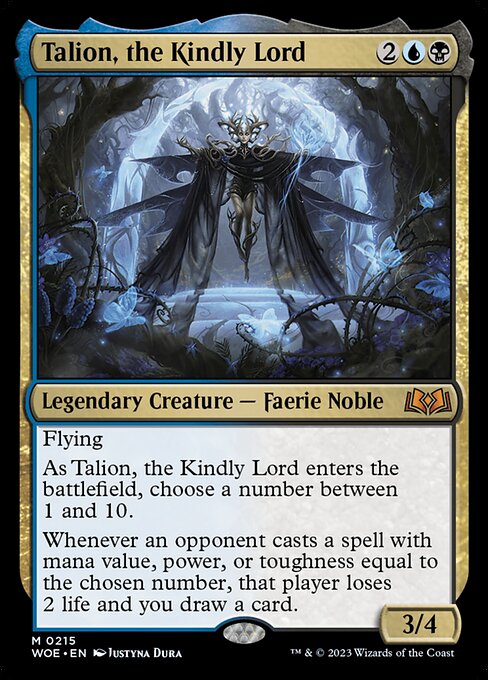
Talion, the Kindly Lord is a striking fusion of elegance and menace tucked inside the Wilds of Eldraine. A Legendary Creature — Faerie Noble with flying, he enters the battlefield not just to impose a stat-line of 3/4 for 4 mana, but to set the stage for a game of numbers and gambits. You choose a number between 1 and 10 as Talion enters, and the magic unfolds as the number’s fate ripples through each spell your opponent casts. It’s a flavor-bright reminder that Eldraine’s courtly intrigue isn’t just about blades and bards—it’s about the quiet arithmetic of consequence 🧙♂️🔥💎. This blend of aristocratic charm and ruthless card design makes Talion a focal point for the recurring cast of figures who orbit Eldraine’s fairy-tale world, and it invites fans to imagine the long, winding relationships that shape his legend 🎲🎨.
In the broader arc of MTG lore, Talion sits in a sunlit, yet shadowed, pocket of Eldraine’s fairy court. The realm thrives on alliances, rivalries, and the cunning that comes from centuries of courtly games. The card’s flavor aligns Talion with a network of recurring figures who show up in various stories and card lines: the loyal Faerie nobles who populate the Court, the nimble enchanters who bend spectacle into effect, and the human retainers who keep the wheels turning in the background. The result is a tapestry where Talion’s kindness isn’t a blanket emotion but a strategic posture that invites both collaboration and peril, depending on who you place on the board with him 🧙♂️⚔️.
Allies across Eldraine’s fairy-tolk court
Talion’s allies are less about named friends and more about shared lineage—the Faerie Noble archetype and the Court’s network of wit, flight, and misdirection. Think of fellow fae nobles who bring flying in, charm, or trickery to the table, and the courtly spellcasters who weave enchantments with a smile. There’s a sense that Talion travels with a cadre of familiar faces: members of the faerie court who understand that power in Eldraine isn’t merely brute strength but the choreography of outcomes. These allies reinforce Talion’s identity as a guardian of the court’s delicate balance, ready to leverage sudden turns in a game with a well-timed spell or a well-placed illusion 🧙♂️🎨.
- Fae nobles and court tricksters who share Talion’s love of games and gambits, offering a backbone of resilience when the table grows tense.
- Court wizards and mystics who provide the spellcraft needed to maximize the number-selected trigger, turning a single choice into multiple draws and life-loss echoes 🧙♀️💫.
- Royal circle allies—patrons and patrons’ entourages who appear across Eldraine’s Throne and Wilds stories—tethering Talion to a larger political landscape where every spell cast carries a price.
Rivals and the web of intrigue
No fairy tale is complete without rivals, and Talion’s sphere is no exception. Eldraine’s rivalries tend to be layered—between rival noble houses within the fairy court, between schemers who distrust Talion’s popularity, and between spell-slingers who seek to outrun his chosen-number trigger. The thrill comes from watching how different players adapt: opponents who cushion their hand to avoid high-value spells, or those who bait Talion into a misstep and break the tempo of the game. In that sense, Talion embodies a recurring motif in Eldraine: power is shared, but it must be negotiated at the count of a card drawn or a life paid. The dynamic is a delightful blend of elegance and threat, punctuated by a chorus of amused smiles around the table 🧙♂️🔥.
Rivals aren’t just antagonists; they are part of the courtly ecosystem that gives Talion’s abilities their texture. When an opponent carefully times a spell with mana value equal to the chosen number, Talion’s effect asks players to weigh risk against reward, a classic fairytale mechanic dressed in spellcraft. The tension between Talion’s “kindly” persona and the ruthless arithmetic of his trigger is precisely the kind of storytelling that makes Eldraine’s lore feel like a living, breathing storybook—one where every chapter is decided by a single, cunning decision ⚔️🎲.
Flavor, art, and the design philosophy
Justyna Dura’s art for Talion captures the paradox at the heart of the card: a noble, gracious demeanor wrapped around a ruthless game. The wings, the lace, and the smoky, moonlit palette evoke a courtly ambiance that is both inviting and dangerous. The two-color identity—B, U—suits Talion’s dual nature: elegance in form, calculation in action. The lore text’s refrain about choosing a number and the life-loss/card-draw payoff echoes the fairy-tale trope of bargains struck in candlelight, where kindness can hide a sharper blade. This is Magic design at its best: a memorable character who invites both flirtation and strategy, spurring players to build around a recurring cast of characters who keep reappearing across sets and storylines 🧙♂️⚔️.
“As Talion enters, choose a number between 1 and 10. Whenever an opponent casts a spell with mana value, power, or toughness equal to the chosen number, that player loses 2 life and you draw a card.”
Playstyle, compatibility, and EDH considerations
Talion shines in two-color decks that lean into tempo and card advantage. In formats where you can pair strategy with disruption, Talion’s trigger rewards you for maintaining pressure while out-valuing your opponent’s bigger spells with recurring draws. In multiplayer formats like Commander, Talion’s ability becomes a chess clock: as numbers become the chorus of the match, you’re incentivized to anticipate opponents’ spell choices and punish repeated value plays. The card’s mythic rarity signals its standout role in a deck that wants strong late-game inevitability, while its foil and nonfoil finishes offer a collectible sheen that mirrors the shard of a faerie court’s crystal chandelier. With an EDHREC rank around 1325, Talion has carved a niche for players who love blue-black finesse, synergy-driven play, and a little courtly drama on the side 🧙♂️💎.
Value, collectibility, and market snapshot
Talion’s price tags reflect its mythic status and the enduring appeal of Eldraine’s fairy court. The listed USD price sits around $7.99, with foil variants offering extra luster for collectors who chase the visual sparkle of a well-loved card. The European market shows a similar story, with modest variations across currencies. For collectors and players alike, Talion represents a prime example of how a single card can be both a competitive engine in certain builds and a flavorful centerpiece in a lore-rich commander table. The card’s presence on marketplaces and its role in story-centered decks keep it relevant, even as new sets swirl into the calendar 🧙♂️💎.
If you’re looking to complement your MTG collection with gear that matches the luminous, game-night vibe, consider this neon accessory that keeps your card-scouting vibe on-brand: a neon phone case with card holder and MagSafe storage. It’s a playful nod to the collectible mindset that fuels Magic fans—the kind of product that sits at the intersection of style and strategy.