Image courtesy of Scryfall.com
The psychology of rarity
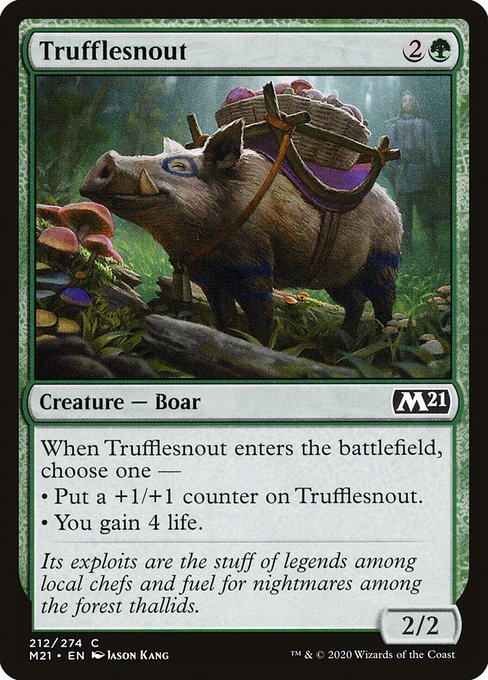
Collectible cards are more than glossy cardboard and cool artwork; they’re vessels of memory, strategy, and social currency 🧙🔥💎. In Magic: The Gathering, rarity isn’t just a label—it’s a reflection of supply, demand, and the emotional arc of a player’s journey. When a set drops, we chase that rush of opening a rare pull or spotting a familiar foil in a trade binder. The green creature you see above might be a common on paper, but its presence in a deck, a binder, or a casual chat can feel like a treasure map that leads to a memorable game night. It’s in this intersection of play value and collector culture that MTG’s psychology of rarity reveals itself, turning ordinary commons into coveted tokens of personal history 🎨🎲.
Meet the card: Trufflesnout as a case study
From Core Set 2021 (M21), Trufflesnout is a green creature — Boar — with a modest mana cost of {2}{G}. A 2/2 creature, it isn’t aiming to win races on power alone. Its entry brings a dual choice: put a +1/+1 counter on this creature or you gain 4 life. The mana curve is gentle, the green theme is clear, and the design invites players to lean into tempo or survivability depending on the game state. The card’s rarity is listed as common, yet its effect—on entrance, a decision that shapes the moment—lends it surprising depth for a common creature. Its existence in the Core Set 2021 lineup matters because it embodies a core truth about rarity: impact, not just rarity, is what lingers in memory ⚔️💎.
Its exploits are the stuff of legends among local chefs and fuel for nightmares among the forest thallids.
That flavor text isn’t just whimsical lore; it sketches a mood, a world where food, danger, and fantasy mingle. It’s the kind of line that makes players grin when they draft or pull a copy in a trade, reinforcing the idea that even a common card can carry personality and story—an essential thread in MTG’s tapestry of rarity and myth 🌲🧙♂️.
Rarity in practice: price, priority, and play
Trufflesnout’s marketplace footprint is instructive. In digital scans and collector listings, its price sits modestly in the penny realm for nonfoils (~$0.05) with a hovercraft foil bump (~$0.08). In euros, it sits around €0.11, with foil nudging slightly higher. These numbers aren’t jaw-dropping, but they illustrate a broader truth: rarity isn’t only about sticker price. It’s about how players perceive value in the context of a card’s playability, nostalgia, and the thrill of finding a useful piece in a deck or a binder. Common cards that see play in Commander or niche Modern/Legacy shells can carry outsized emotional value, especially when paired with a memorable ability or a beloved flavor text. The card’s EDHREC rank and other metrics might not scream “must-have,” but the joy of adding Trufflesnout to a green-stompy deck or a lifegain-focused build can be priceless to the right collector or player 🧙🔥🎲.
Let’s connect the math to the moment: the card’s effect on entering a brawl can be a swing factor in a board state. The choice between +1/+1 on this creature or lifegain gives a player a mental model for risk assessment—should you push your tempo by growing the boar, or stabilize by stacking a life buffer? That decision becomes a micro-story in a game and, over time, a narrative players share when they reminisce about a deck’s early turns or a surprising life swing at a table. The psychology of rarity, in this sense, is also a psychology of memorable moments 🧙🔥.
Design, art, and the collectible loop
The art of Trufflesnout, credited to Jason Kang, and its 2015 frame in the M21 set emphasize how MTG designers weave flavor into function. The creature’s stance, the earthy greens, and the quirky name fuse humor with a tactical foothold. In a world of mythic rares and ultra-rare showcase foils, a common can still feel special when it arrives in your mailbox with a crisp foil alternative or during a draft night that becomes legend. The collectible loop thrives on such contrasts: ordinary becomes cherished when imagination, play, and community intersect. The art’s color, the language of the ability, and the card’s placement in a set all contribute to a lasting memory, which in turn fuels the desire to collect, display, and trade 🖼️🎨.
Collector mindset: why players chase even the humble
Collectors aren’t only chasing the rarest cards; they’re chasing experiences. A common card like Trufflesnout becomes a badge of the deck you piloted, a reminder of a fun draft, or a trade that sparked a conversation with a friend. The psychology here is straightforward yet powerful: scarcity interacts with personal narrative. When you open a pack and pull a card that both feels useful in play and flavorful in story, you’re staking a little claim in the MTG multiverse. And in the modern ecosystem—where everything from foils to card holders enters the conversation—the allure broadens to include display pieces and accessories that carry the same sense of discovery and pride 🧙🔥💎⚔️.
Cross-promotional moment: practical accessories for the serious collector
As you curate a shelf, binder, or forget-me-not deck, consider how a stylish accessory can complement your collection. For those who want to showcase a favorite card like Trufflesnout with flair, a neon card holder phone case can be a bright, playful addition to your setup. It’s a tangible reminder that even the smallest item can echo the magic of the game. If you’re looking to upgrade your display while you chase your next chase card, this could be your next subtle, delightful upgrade 🧙🔥🎲.
For a practical way to support your hobby while adding a splash of color to your table, check out the Neon Card Holder Phone Case Glossy Matte Finish. It’s a playful nod to the bright personalities of MTG’s community and an easy way to keep your prized possessions safe between sessions.