Image courtesy of Scryfall.com
Artist-Designer Collabs That Elevate MTG Cards
Magic: The Gathering has always thrived on collaboration—between color philosophies, between florid lore and cool mechanical tricks, and most delightfully, between the artists who paint the multiverse and the designers who translate a vision into a playable spell. When those two creative engines finally collide, the result is more than a card; it’s a tiny cultural moment you want to study, imitate, and maybe even frame. The Unfinity era gave us a perfect case study in this dynamic, a card whose very concept feels like a celebration of teamwork, wit, and the joy of the game. 🧙♂️🔥
Case study: a playful subgame in a single spell
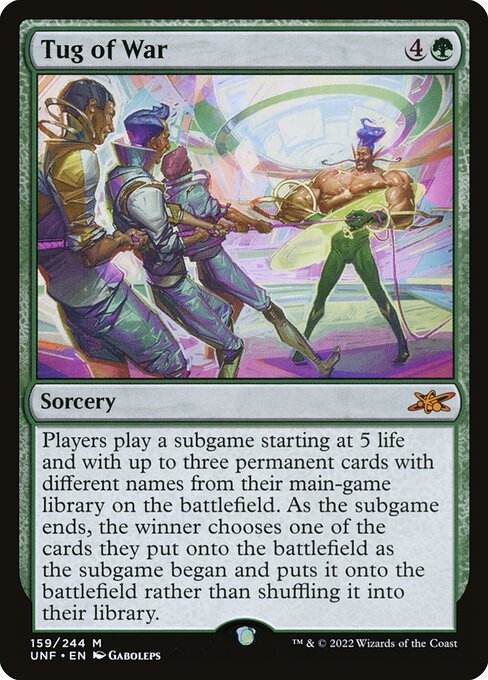
In Unfinity, a set famed for tongue-in-cheek humor and cinematic flavor, Tug of War stands out as a bold exercise in collaborative design. This green sorcery costs {4}{G} and arrives as a mythic rarity—an indicator that it’s not simply a trap or a bomb, but a statement piece. The card’s oracle text runs in two acts: it invites players into a subgame that runs on its own internal logic, and then it resolves with a high-stakes choice that carries the momentum of the main game forward. The subgame begins with each player putting up to three permanents onto the battlefield from their libraries, each with a different name, and it does so at life total: 5. When the subgame ends, the winner picks one of the cards they put onto the battlefield for the subgame and keeps it on the battlefield, rather than shuffling it away like a typical fetch. It’s a wild, almost theatrical, reminder that card design can be as much about story as it is about raw power. ⚔️
That the card is illustrated by Gaboleps—an artist whose work is recognizable for its expressive characters and vibrant, almost carnival-like energy—already signals a collaboration that isn’t afraid to lean into spectacle. The Unfinity set, with its borderless playfulness and security-stamp acorns, leans into the idea that magic can be both a puzzle and a playground. When you pair a subgame mechanic with a vividly creative illustration, you lean into the core MTG truth: players don’t just cast spells; they participate in a shared narrative where every decision can tilt the stage in a different direction. 🎨
As Mark Rosewater hinted during preview discussions, this card embodies a design philosophy where rules tension and visual storytelling coexist. The subgame isn’t just a gimmick; it’s a platform for strategic experimentation and narrative flair.
Design synergy: how art and mechanics reinforce each other
- Visual storytelling informs mechanic scope: The idea of a tug-of-war—literal back-and-forth tension—translates into a mechanic that forces players to manage risk and reward across two concurrent experiences: a subgame and the main game.
- Set philosophy amplifies the concept: Unfinity’s “funny” theme gives designers room to experiment with subgames, probability, and player psychology without the burden of a grim or deadly lore. The artistic direction from Gaboleps complements that whimsy, turning mechanical innovation into a cohesive, shareable moment. 🧙♂️
- Green’s natural affinity for creatures and board presence: While Tug of War isn’t a pure ramp spell or a big-stomp finisher, its green identity capitalizes on growth, terrain control, and the joy of creating a visible, tangible battlefield. The collaboration here celebrates the green archetype’s love for big, imaginative board states and the drama of “what if” scenarios. 💎
Practical play insights: building around a subgame
For players who love to twist open a new design space, Tug of War rewards careful deck-building. Since the subgame requires up to three permanents with different names from the library, it nudges you toward versatile tutors or card drawers that reliably fetch varied permanents. In a deck aiming to maximize the subgame’s payoff, you’re looking for a spread of shells—different names that can all hit the battlefield—so that the subgame feels less like cryptic luck and more like a planned, exhilarating contest. When the subgame ends and the winner picks a card to keep on the battlefield, you’re not just stealing tempo; you’re anchoring the narrative of the game’s turn structure and forcing your opponent to respond to a evolving board state. It’s a cool reminder that in MTG, tempo, text, and art aren’t isolated silos; they feed one another. ⚡🎲
That subgame is a microcosm of design intent: give players a distinct, memorable choice that feels both intimate and monumental, all within a single spell. It’s the kind of card you show off at tables, then quietly craft a deck around for weeks. 🔥
Collector’s view: rarity, accessibility, and the magic of a well-loved collaboration
From a collector’s lens, this card’s mythic rarity and Unfinity’s iconic “funny” framing make it a standout piece for fans who chase both art and ideas. The card’s price tag—historically modest in the broader MTG market—reflects its position as a distinctive but not game-breaking miracle. Yet the true value lies not in numbers alone but in the memory it creates: the memory of watching a subgame unfurl, of weighing which of your three differently named permanents to commit to the battlefield, and of enjoying Gaboleps’s dynamic artwork every time you draw it. The design is a celebration of collaboration between the artist’s eye and the designer’s constraint-based magic, a reminder that collaboration often yields the most enduring magic. 🧙♂️💎
Looking ahead: what collaborations teach us about the future of MTG design
One of the enduring charms of MTG is watching how collaboration evolves across sets and eras. When artists and designers work in tandem, you get cards that feel less like isolated spells and more like storytelling devices—miniatures with rules that encourage you to imagine the larger world around them. Tug of War is a microcosm of that philosophy: a card that looks playful, reads like a puzzle, and behaves like a small theatre where players perform a turn-by-turn performance. The ongoing hope is that future collaborations continue to blend artistry with design constraints in ways that feel innovative, legible, and just a little mischievous. And if you’re a fan who loves both crafting lists and admiring art, these moments are the ones you’ll return to again and again. 🎭⚔️