Image courtesy of Scryfall.com
Tabletop Psychology of Funny MTG Cards: A Closer Look at Urza
In the grand tapestry of Magic: The Gathering, great drama often unfolds around the biggest spells and the flashiest combo lines. Yet some of the purest entertainment happens when cards lean into the absurd—the kind of humor that makes players grin, groan, and sometimes misread the board entirely. Urza, a Vanguard card from the Vanguard Series, is a prime example of how a single, quirky design can become a social moment at the table 🧙🔥💎. The moment you lay out a card that looks regal, then read its text and realize it’s not about power so much as theatrical timing, you’ve tapped into MTG’s delightful tension between lore, rules, and table psychology.
Design quirks that trigger a smile
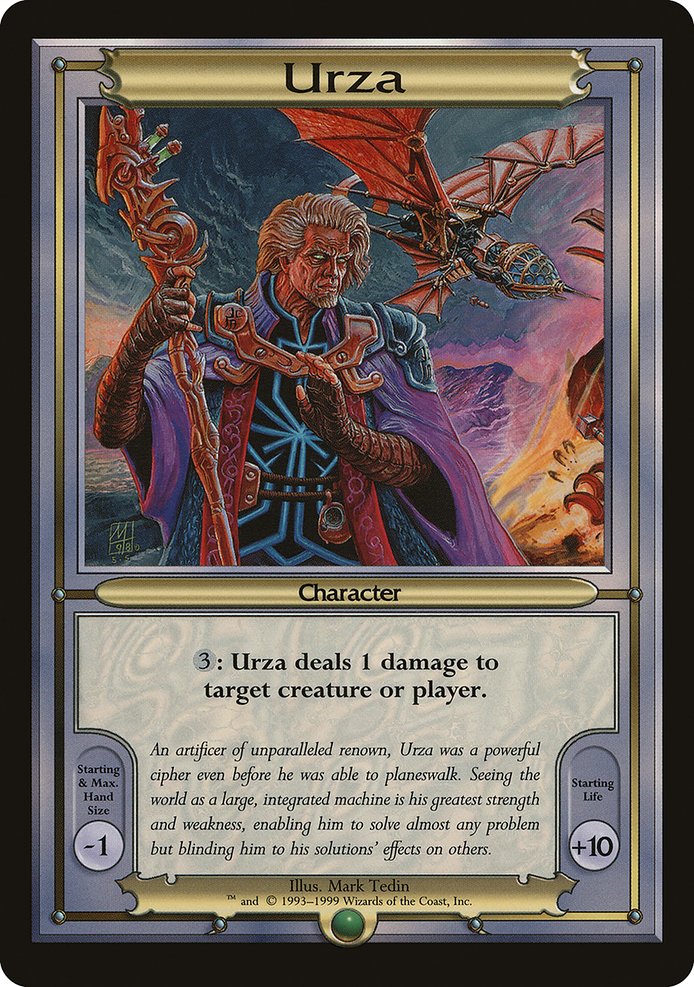
Urza is a Vanguard card with a very specific character and a very specific utility. It’s colorless, with no mana cost (cmc 0), and it lives in a rarified space within the game’s history: a rare, oversized card that’s more about the aura of Urza than raw efficiency. The oracle_text—“{3}: Urza deals 1 damage to any target.”—reads like a wink: a legendary artificer who can unleash a precise poke, but only after you’ve paid three mana for a tiny payoff. The humor isn’t in a big damage spike; it’s in the way the card commits to a persona. Urza the artificer, who sees the world as a machine, is now a machine for micro-damage, a perfectly calibrated joke about scale and expectation ⚔️.
The life modifier and hand modifier add another layer to the comedy. A +10 boost to life total sits alongside a -1 to hand size, which creates a playful push-pull: you’re suddenly more durable, but you’re also a card or two lighter in your grip. In casual play, this can prompt conversations about timing, risk, and how far players are willing to push Urza’s seeming “everyman” plan into the absurd. It’s a reminder that MTG isn’t just about winning; it’s about telling a story with every draw and every ping 🎲.
Flavor, lore, and the art that sells the joke
The flavor text for Urza reads, "An artificer of unparalleled renown, Urza was a powerful cipher even before he was able to planeswalk. Seeing the world as a large, integrated machine is his greatest strength and weakness, enabling him to solve almost any problem but blinding him to his solutions' effects on others." That line underscores the humor: Urza’s genius is both a gift and a trap, and the Vanguard card distills that irony into a single, memorable moment on the table. Mark Tedin’s illustration—classic 1993-frame flair—captures the professor-at-work vibe: schematics, glow, and a smile that says, “I’ve calculated the odds, now watch me pretend I’m done after one more ping.” It’s art that invites you to lean into the gag while still treating the character with respect 🎨.
From a mechanics perspective, the card’s layout and type—Vanguard—set expectations for players who know the old school Vanguard formats and their quirky decks. The set, Vanguard Series (pvan), is a nod to the long-running tradition of unique, often experimental cards that exist on the fringes of standard play. Even as Urza sits on the sidelines in most modern games, the card remains a cultural touchstone for nostalgia-driven players who remember how “tabletop magic” used to feel in the pre-modern era.
Tabletop psychology: how funny cards shape play and talk
- Presence beats punchline: A card like Urza doesn’t win with a flashy text box; it wins with presence. The oversized design and the aura of a legendary artificer at the table prompt players to react with exaggerated respect or theatrical skepticism, depending on the mood of the game 🧙🔥.
- Anticipation vs. payoff: You hold Urza, you declare the ability, you wait for the moment when the three-mana cost finally delivers a single damage token. The delay can be funnier than the result, turning a mundane ping into a little ritual of suspense ⚡.
- Life tanking and hand shrinkage as humor accelerants: The +10 life and -1 hand create a built-in joke about “growth with constraints.” Players often riff about how much life is enough to survive a brutal surprise and how much a dwindling hand can hamper or heighten the drama of the next draw 🧩.
- Flavorful conflict with rules lightness: Urza’s utility invites players to debate whether the humor is in the text, the lore, or the inevitable misreads. The conversation becomes as entertaining as the ping itself, a hallmark of MTG’s communal storytelling 🎲.
“Sometimes the most brilliant strategy is knowing when to laugh at the board.”
Collector value, history, and what this card means today
Urza’s rarity is listed as rare, and the card hails from a time when vanguard products celebrated novelty and tabletop culture as much as card power. The card image shows an ink-and-machine aesthetic that collectors love: an artifact of a bygone era that champions nostalgia as a collectible motive. On the market, the card’s value sits in the double-digit territory in USD and euros, reflecting both its rarity and its place in MTG lore. The flavor text and art contribute to its charm, making it a conversation piece in a binder just as much as a potential game piece for a casual triad of players who enjoy a good joke alongside their draws.
For players who want to echo that playful energy in the real world, there are delightful crossover touchpoints. The product ecosystem around MTG culture thrives on accessories that celebrate the game’s personality—fun card holders, playful playmats, and even lifestyle items that nod to the game’s humor. If you’re looking to blend the practical with the playful, a well-chosen accessory can carry the same vibe Urza embodies on a friendly Friday night, especially when you’re fielding a deck heavy with nostalgia and wry wit 🧙🔥💎.
As a piece of tabletop theatre, Urza remains a delightful reminder that MTG’s most enduring appeal lies not only in the power of its spells but in the stories we tell about them. A rare Vanguard card with a tiny, precise punch—three mana for a single ping—paired with a generous life buffer and a slight hand tax, makes for a memorable table moment. It’s the kind of card that invites a group chat after the game: “Remember the Urza ping? Remember the glare when the life total ticked up to ten?” And that, friends, is the magic of table psychology in action 🧙🔥🎲.
Curious to bring a little of that vibe into your daily carry? Check out the cross-promotional pick below and keep the table legends alive in more than just memory.