Image courtesy of Scryfall.com
Social Media Trends and Decks Surrounding a Black Class Enchantment
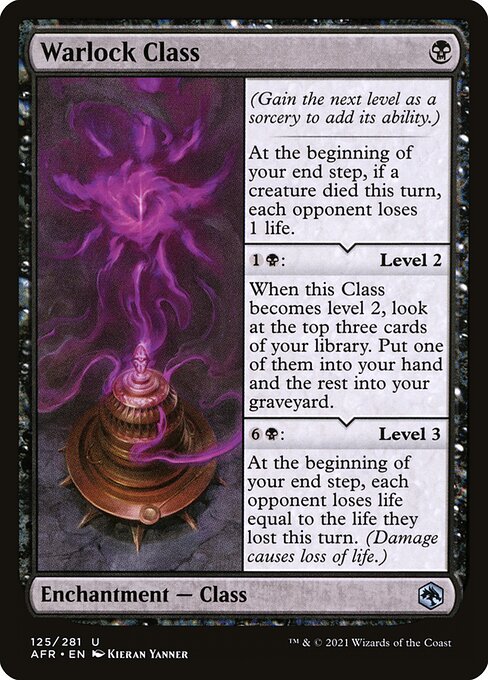
If you’ve been lurking in MTG circles on Twitter, Reddit, or the various deck-building Discord servers, you’ve likely seen a surge of chatter about a certain black enchantment with an unusual leveling arc. The card sits in Adventures in the Forgotten Realms, a set famed for its D&D crossover vibes, and its class-structure has become a talking point as players tease out its potential in Commander and casual games alike 🧙🔥. The buzz isn’t just about power; it’s about the way this card invites a narrative arc—level up, push your engine, and watch your opponents pay for every creature that dies under your watch ⚔️💎.
What’s driving the conversation?
- Leveling as a design conversation: The Class mechanic presents a built-in progression path. You start at Level 1 for {B} and can advance to Level 2 with a small investment of {1}{B}, then to Level 3 with a heavy commitment of {6}{B}. That staged approach has sparked lively debates about tempo, inevitability, and the kinds of coin-flips you want to take in a world where “level up” effects refer to your own development and board state rather than a static card line. It also invites memes about “leveling up” in life and in loot boxes—since the top-card look at Level 2 often feels like a turbocharged card draw with graveyard synergy 🃏🎲.
- Graveyard as a resource hub: Level 2’s ability to look at the top three cards and select one to draw—while sending the rest to the graveyard—has fueled discussions about fuel for reanimation, delve, flashback, and other graveyard-centric strategies. The tweets and threads glow with GIFs of players tossing cards into the yard and then pulling a critical piece from the top three—like a cinematic reveal that favors the grinder over the blitz.
- End-step life-lost echoes: At Level 1 you’re potentially setting up a world where creatures dying can become a forcing function for everyone at the table. At Level 3 you’re pushing a more aggressive line: each opponent loses life equal to what they’ve lost that turn, on your end step. It’s a mechanic that begs for surgical combos with aristocrat-style outlets, sacrifice paysoffs, and careful timing to maximize impact across a multi-player table 🧙🔥.
- Accessibility and price-talk: The card sits at an approachable price point in nonfoil form (USD around 0.16) with foil showing a modest bump. That accessibility is a magnet for newer players and budget-conscious commanders who still crave a flavorful engine. In social threads, fans celebrate the card’s potential without känk-forcing wallet damage, while collectors keep an eye on foil variants for their art and rarity charm 🎨.
Archetypes that have found a home with this Class
Black has always leaned into inevitability—board control, recursion, and the occasional “blow up the table” finisher. Warlock Class prompts a cascade of synergy ideas that are thriving in online chatter:
- Aristocrats and sacrifice themes: Cards like Blood Artist, Zulaport Cutthroat, and other sacrifice outlets turn creature death into real value while the end-step lifeloss at Level 3 provides a cumulative pressure that can tax opponents over the course of a game. The social-media reaction often features clips of boards where one well-timed sacrifice swing ripple-effects across every opponent.
- Graveyard-forward strategies: Since Level 2 reveals top cards to the hand while discarding the rest to the graveyard, players are pairing this with graveyard-filling engines and reanimation spells. It’s a natural pairing with cards that care about the graveyard, creating a thematic thread that fans love to post about—especially when a bold top-deck swing is followed by a comeback in late-game spots 🎯.
- Direct-damage mileage and life tax: The Level 3 payoff—opponents losing life equal to their own losses this turn—encourages “life tax” lineups and punishing aggression. It’s a perfect match for commanders who like to amplify lifeloss interactions or who want an alternate win-con path that’s not the usualcombo-mill or stat-stacker route.
Practical deck-building notes shared by the community
While the community experiments with many permutations, several practical threads have emerged in posts and decklists. If you’re drafting a budget-friendly black build or tuning a Commander list for social play, consider these touches:
- Graveyard interaction matters more than raw card advantage at Level 2. Prioritize cards that enable a favorable yard-to-hand exchange while filling your graveyard for later reanimation or delirium-style payoffs.
- End-step timing makes interaction with opponents’ boards crucial. Leave mana available on your own turns to protect your engine and to ensure you can cast or recast key pieces when the moment arrives.
- Assist engines include sacrifice outlets, repeatable value generators, and tutors or card-draw spells that align with your Level 2 pick. The top-three reveal can be leveraged to fetch a must-answer play or a way to refill your hand after a sweep.
“Level up your game, not just your mana curve—the class reward is a narrative crescendo that invites table talk and clutch plays.” 🧙♂️
Flavor, art, and the community glow
The card art by Kieran Yanner—tinted with the moody, D&D-flavored aesthetic from AFR—sells the vibe of a figure steadily embracing a darker path. The art’s mood feeds the online memes and fan art that flourish when players imagine a class growing into a feared presence at the table 🎨. In the era of crossovers, it’s a small but satisfying bridge between planeswalkers and spell-slinging archetypes, inviting fans to tell stories about their own “class progression” in sealed and standard-adjacent formats.
For those who like to map trends to trends, the social chatter around this enchantment often threads together with Commander’s evergreen appetite for long games, value generation, and multi-opponent reach. If you’re posting about it, you’ll likely see replies with decklists, quick clips of end-step life drain, and debates about the best level to plant your flag in a game that could tilt in two or three key plays 🧙♂️💎.
And yes, the conversation isn’t just about power—it’s about the storytelling that MTG excels at when a card’s mechanics mirror a character’s growth arc. The Level-up vibe mirrors old-school class cards and the way players historically describe their progress as the game grows more complex. It’s proof that mechanics can be both flavorful and mechanically interesting, a rare combo that fuels both casual smiles and deep strategic planning ⚔️.
If you’re looking to explore this theme deeper, a comfortable way to start is to pair the card with classic black-outcome staples and then pivot into graveyard-friendly engines. And while you’re arranging your next table, perhaps you’ll reward yourself with a sturdy accessory that keeps your phone safe on the go—a rugged case built to handle the tempo of FNM and weekend scrimmages alike. Product links and promos live alongside the community chatter, reinforcing that MTG is as much about the journey as the destination.