Image courtesy of Scryfall.com
What the Desert Is Saying Without a Cue: Color Psychology in MTG Art
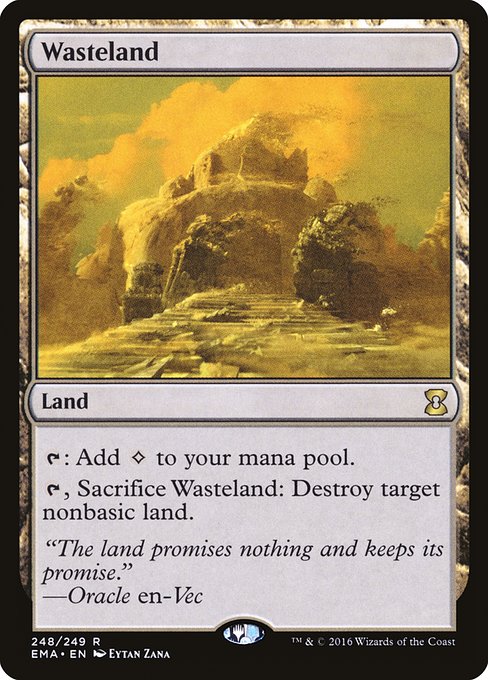
There’s something almost medieval about Magic: The Gathering’s ability to whisper color psychology through brushstrokes, shading, and composition. When you lay down Wasteland from Eternal Masters, you’re not just playing a land that taps for colorless mana; you’re entering a dialogue about how color and tone convey meaning in a world where mana colors represent ideals, ethics, and tendencies. 🧙♂️🔥 In this desert tableau, the artist Eytan Zana leans into earth tones and weathered textures to craft a feeling that is as much about scarcity as it is about power. The result is a card whose art teaches players to observe, not just to act, and to see how colorless assets can still carry a vivid psychological charge. ⚔️💎
Palette as a Language: Desolation and Discipline
Wasteland uses a deliberately restrained palette: dusty browns, chalky grays, and faint sunburnt oranges. It’s a color story that says, quietly and firmly, that momentum doesn’t come from bright, saturated hues here—it comes from restraint and consequence. In MTG color psychology, white and blue often evoke order and intellect with stark contrasts; black taps into decay and inevitability; red emits urgency and impulse; green exudes growth and life. But this piece sits outside that wheel. It leans into colorlessness as a thematic stance: the land itself offers a bare, honest resource in sea of color-rich possibilities, and it wields a different kind of authority. The absence of color creates a sense of discipline—an anchor that says, “In a world where everything is loud, sometimes silence is loudest.” 🎨🧭
- Colorless identity: The land’s mana ability to produce only generic color mana mirrors MTG’s concept that some effects don’t belong to a single color—they belong to the battlefield itself. The art communicates neutrality, a canvas for any strategy rather than a beacon for a particular color philosophy. 🧙♂️
- Desert as metaphor: The arid landscape is a visual metaphor for scarcity and control—two themes that colorless or "color-free" tools frequently embody in play design. The image invites players to think about how to wield resources when your options are limited, not abundant. 🔥
- Nonbasic disruption as a colorless skill: The card’s ability to destroy a nonbasic land with a sacrifice speaks to a meta where land quality matters as much as raw mana production. It’s a reminder that colorless tools can wield decisive clout in the right hands. ⚔️
Flavor Text and the Psychology of Promises
The flavor line, "The land promises nothing and keeps its promise," deepens the psychological thread. It’s a wry commentary on expectation in a multiverse where players invest in lands, enchantments, and mana bases that often look endless but can be fragile. The line reinforces a stoic, almost stoic-robotic view of strategy: the wasteland won’t gloss over your missteps, it will reveal them. This tension between expectation and outcome is what many colorless and artifact-centered decks lean into, and the art reinforces that mindset with a visual economy that mirrors the text. 🤝💎
In MTG, color is as much about philosophy as it is about mechanics. Wasteland’s art makes you question whether you’re building toward a grand color-based plan or forging a lean, resilient path that thrives on what remains when other lands fall away.
Rarity, Collectibility, and the Art of Reprints
As a rare in Eternal Masters, Wasteland sits in a unique niche. EMA’s Masters set reprints love to pull older staples into the modern frame, preserving nostalgia while offering new printings for collectors and players revisiting classic archetypes. The rarity signals a certain prestige in many collections, especially when the associated artwork—Eytan Zana’s desert texture work—remains a point of pride for fans who admire the ability to tell a story through a single frame. The card’s price range, with a foil version often standing a notch above its nonfoil cousin, reflects both demand for nonbasic land destruction options and the allure of its art. If you’re chasing the emotional resonance of color through landscapes, this piece is a compelling anchor in any collection. 🧿🃏
Practical Play Values: How Wasteland Shapes Strategy
In terms of gameplay, Wasteland’s ability set makes it a staple for decks that value tempo denial and strategic disruption. Its primary function is to create a cost for opponents who lean heavily on nonbasic lands—think fetchlands, cycles, flight paths, and other utility lands that broaden a deck’s color pie and mana options. The card’s mana-neutral nature means it doesn’t tilt your own color balance; instead, it punishes over-reliance on “land base diversity” by targeting the opponent’s. In Commander or Legacy formats, a well-timed Wasteland can swing the board by tearing down a critical nonbasic land location, stalling dvandamaging color-schemes you’d otherwise be rushing toward. The art’s mood—the desert as a patient, inexorable force—echoes this calculated, patient approach to board control. 🧙♂️⚔️
- Timely taps: Use Wasteland early to protect your plan while forcing opponents to navigate scarce resources.
- Colorless synergy: Pair with support spells or artifacts that benefit from colorless mana or that punish overextension.
- Deck archetypes: Lands-mcrew decks, slower control builds, and multi-color strategies that rely on nonbasic lands can all leverage Wasteland’s potential.
For players building around MTG’s broader color psychology, Wasteland stands as a reminder that art and mechanics can illuminate a strategy without forcing a single color into the spotlight. The barren landscape asks you to design a plan that respects the land as a character—one that’s patient, persistent, and precise. And if you’re curious to explore more of the same vibe—where strategy meets aesthetic storytelling—there’s a curious crossover you won’t want to miss. The linked product below offers a practical, modern gadget that keeps your everyday life in order while you chart your next MTG victory. 🔥🎲