Image courtesy of Scryfall.com
Searing Blood and Mulligan Mindset: Thresholds for Red Aggro
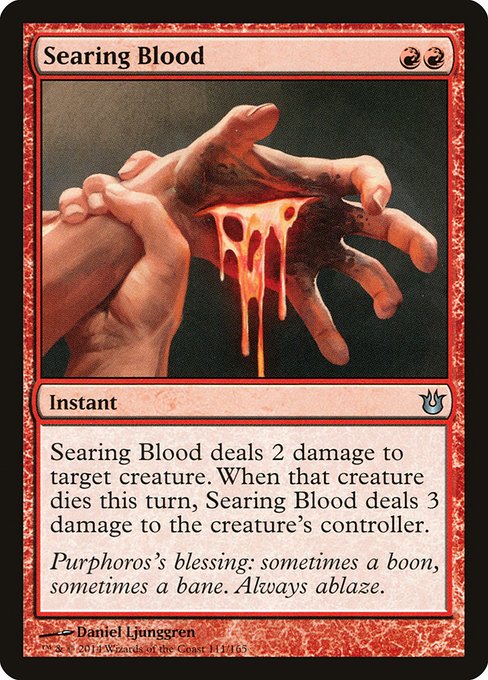
When you’re staring down a seven-card hand that includes Searing Blood, the question isn’t just “Can I cast it?” but “Should I keep this hand at all?” This two-mana slam, a vivid burn spell from Born of the Gods, asks you to measure tempo almost as much as you measure mana. With its {R}{R} cost, Searing Blood instantly trades a card for momentum: 2 damage to a chosen creature, and if that creature dies this turn, the spell pings the opposing player for 3 additional damage. It’s a compact burst of pressure 🧙♂️🔥💎⚔️, and the right mulligan decision can be a game plan in miniature. Here’s how to think about it like a pro, whether you’re racing on the arena floor or drafting your way through a draft night with friends 🎲.
What Searing Blood brings to the party
First, a quick reminder of the card’s lore and mechanics. Searing Blood costs two red mana and targets a creature. The immediate 2 damage is straightforward: it forces an early tempo swing, often taking a blocker off the board or pressuring a 2/2 if your opponent plays a small evasive. The kicker—its payoff if that creature dies this turn—adds a cruel, extra layer of burn: you’re not just removing a threat, you’re turning its fall into burn on the opponent 🧙♂️🎨. In the context of Born of the Gods (BNG), this common/uncommon red instant fits the red archetypes that want to push damage quickly and cleanly. The flavor text is a playful nod to Purphoros’s blaze: “Purphoros's blessing: sometimes a boon, sometimes a bane. Always ablaze.” That blaze translates into decisions where you’re counting on a creature dying and the board status to maximize value ⚔️.
“Purphoros’s blessing: sometimes a boon, sometimes a bane. Always ablaze.”
Keep or mulligan: read the two-card tempo map
When you’re deciding to keep Searing Blood in a hand, you’re really asking two questions: (1) Do I have the red mana bases ready to enable an early cast? and (2) Do I have a plan that uses this spell to either remove a blocker or threaten lethal pressure in the next two turns? If your opening hand contains two red mana sources (or a reliable mana ramp in the red shell), and at least one 1- or 2-drop with a plan to push damage, that’s a hand you’re inclined to keep. If you’re staring at Searing Blood alongside a bunch of non-red cards or a slow curve with no early threat, the mulligan becomes reasonable to consider 🧙♂️🔥.
- Keep if you have: two red sources, Searing Blood, and a cheap compatible spell or threat (like a 1-drop that'll hit the battlefield quickly). This gives you an immediate chance to apply pressure on Turn 1 or Turn 2 and set up the “kill-the-creature, burn-the-player” follow-up.
- Mulligan if you have: no red mana by turn 2, or a hand that’s full of non-red or high-cost cards with no early target for Searing Blood. In these cases, you’re likely to fall behind and waste the card’s tempo you paid for.
- Consider a shallow keep if you have Searing Blood plus a neutral nonland spell that can be cast on Turn 2 with a single red source, or if you’re playing a highly aggressive red deck that expects to start swinging early anyway 🔥.
In Limited formats, where you’re often on a tighter mana curve and your deck’s density matters, this mulligan logic becomes even more critical. If you’re lacking early pressure in your first few draws, cutting losses early with a planned mulligan can preserve the chance to hit a sharper curve—especially in a set like Born of the Gods where red’s tempo often dictates the pace of the game 🧙♂️💎.
Practical mulligan examples you’ll recognize
Imagine you open with Searing Blood in a two-land hand that contains red mana sources and a 1-mana red critter. That’s a keep. You can kill a 2/2 on the first turn and set up a follow-up burn plan. Now suppose your hand is Searing Blood with two colorless cards and a Mountain, but no other threats. You’re likely to redraw into a better curve; the two mana you’re investing into casting a spell that may not immediately win you the game doesn’t feel as efficient. Mulligan. If your hand has Searing Blood but you’re staring down a board full of high-impact creatures and you can’t force the pace, you might want to redraw for a cleaner tempo path 🧙♂️🎲.
Some players like to think of Searing Blood as a tempo enabler for “split damage”—kill a small creature, then push the burn if you can ensure that creature dies within the same turn. This is a nuanced approach that rewards careful reading of combat steps. If your opponent has a single blocker with deathtouch or a plague of evasive fliers, you’ll need to balance the likelihood of killing the creature with the risk that you’ll burn yourself out.
Pairings and practical tips for the table
In constructed red shells, Searing Blood shines when you have synergy with cheap removal and evasive creatures that can threaten a quick line of play. Pair it with creatures that can threaten a quick kill, or with other burn spells that push damage beyond the immediate creature. In limited play, Searing Blood often trades favorably against a single blocker, and if your deck is built to maximize early damage, the extra 3-damage burst can close out games in surprising fashion 🧙♂️⚔️.
Beyond raw play, there’s a psychological edge to consider. In multiplayer formats where threats accumulate, landing Searing Blood at just the right moment can force awkward blocks and create a cascade of death-burnded turns, especially when you’re eking out value from every point of damage. The card’s aesthetic and flavor text also foster a nostalgic vibe for red’s classic “pyro-pump” moments—burning a board while the color identity screams through the plan. The Pro Tour veterans might smile at the memory of a well-timed Searing Blood trigger, while newer players get a crash course in tempo and value 🔥🎨.
As with many red spells designed to maximize tempo, the real art is in knowing when to cast and when to hold. If you’re ahead on the board, a timely Searing Blood can be the exclamation mark that turns a narrow lead into a crushing victory. If you’re behind, it’s still worth considering for the inevitability of a favorable trade—but you’ll want a clean path to Redemption in the next draw step 💎.
For those who love to track card value and design, Searing Blood’s rarity (uncommon) and its dual-phase payoff—early tempo plus post-mortem damage—showcase how a simple two-mana spell can create branching outcomes. The art by Daniel Ljunggren captures a moment of red-hot pressure, mirroring how the card functions in game-state: a small spark that can ignite a longer flame. If you’re eyeing modern reprints or curious about market fluctuations, you’ll notice the foil version carries a noticeably higher price than the nonfoil, a reminder of how art and utility can go hand in hand in MTG collecting 🧙♂️💎.