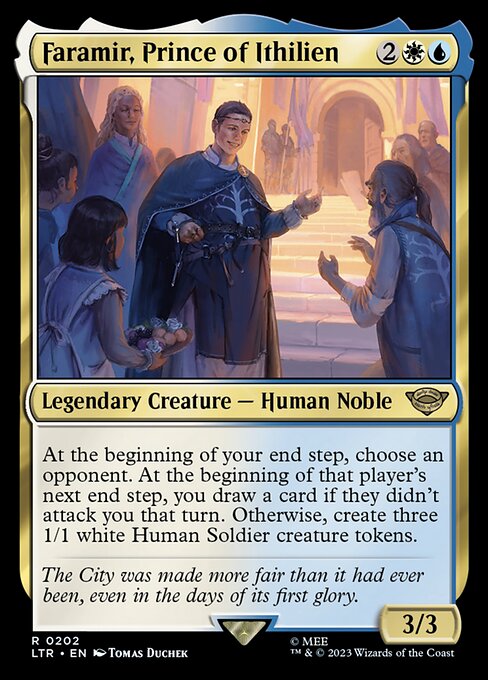
Image courtesy of Scryfall.com
Iconic Art in The Lord of the Rings: Tales of Middle-earth
Magic: The Gathering has always thrived on the intersection of gameplay, story, and the images that carry those stories into our games. Faramir, Prince of Ithilien stands as a vivid example. In the hands of a master illustrator like Tomas Duchek, the card doesn’t just show a character from a beloved saga—it crystallizes a moment of leadership, restraint, and quiet cunning. The artwork, set against the dark armor of Gondor and the pale light of Ithilien, invites you to imagine the politics of Middle-earth as decisively as you imagine the combat math of a curve in a blue-white control shell. 🧙♂️🔥💎
Reading the image: what makes the composition sing
- Character centeredity: Faramir occupies the frame with a calm, almost contemplative resolve. The composition centers on restraint rather than flash, mirroring the card’s strategic identity in gameplay. This is a rare trick—art that reinforces a plan rather than merely decorating a plan. ⚔️
- Light, color, and mood: The palette leans into cool blues and pristine whites, signaling the card’s blue-white identity and its emphasis on intellect, diplomacy, and orderly prowess. The result is a portrait that feels as if it belongs to a council chamber as much as to a battlefield. 🎨
- Iconic silhouettes: Duchek’s lines render a figure you can recognize at a glance across a crowded drafts or a crowded battlefield—exactly the sort of hero you want to follow in a multiplayer arena. 🧭
How art and mechanics reinforce one another
The card’s suite of abilities—two-color identity, end-step decision-making, and a choice that pivots the next turn—lends itself to a lauded “political” playstyle. You pick an opponent at the end step; if that opponent didn’t attack you, you draw a card on their next end step; otherwise you flood the board with three 1/1 white Human Soldier tokens. In art terms, this is a leader who weighs his options carefully, then acts in a way that reshapes the board state with measured confidence. The image of Faramir aligns with a strategy that prizes control and tempo over brute force. It’s a subtle, cinematic reminder that influence can be as potent as firepower. 🕊️
The City was made more fair than it had ever been, even in the days of its first glory.
Flavor text from the card echoes the visual storytelling: leadership, reform, and a sense of duty under pressure. The art invites you to connect that lore to the practical choices you make during a game, especially in formats where diplomacy and timing matter as much as power-leveling—like Modern or Commander. 🧙♂️🔥
Artist, frame, and the lore-bridging set
Tomas Duchek’s rendition appears in The Lord of the Rings: Tales of Middle-earth, a set type categorized as a draft innovation. The card uses the 2015 frame with a black border and a legendary creature station, underscoring its role as a memorable, story-rich piece in a set built around Universes Beyond collaborations. The rare status marks it as a standout for collectors and players alike, with foil and nonfoil versions that glow differently on the table. The art isn’t just decoration; it’s a primer for how we should imagine Faramir in a world where wisdom and strategy guide the narrative just as surely as any blade. 🧙♂️
Where this card fits in decks and why fans gravitated toward it
In terms of gameplay, Faramir, Prince of Ithilien appeals to players who enjoy tempo and political play. With a mana cost of {2}{W}{U} and a power/toughness of 3/3, the card sits comfortably in early threat ranges while offering a late-game pivot. The end-step trigger creates a unique dynamic: you influence your opponents’ behavior by selecting who you want to gauge, and the result can be card advantage or a board-wide token flood. In a world where we measure value in both cards and interactions, this dual outcome—draw a card or summon a swarm—feels thematically true to a strategist who weighs every move against a larger plan. If your meta rewards interaction without sacrificing your own board presence, you’ve found a natural home for this legendary Human Noble. 🧭
Legally, the card is formatted for MTGO, Paper, and Arena play, with a presence in various formats that appreciate its color pairing and political texture. Its rarity, EDH relevance, and the flavor-laden storytelling all contribute to its long-term status in both casual and competitive circles. The card’s positions in community indexes—EDHREC rank within a competitive niche and a collector’s market that recognizes its exclusive set identity—reflect a broader appreciation for how iconic art can heighten a card’s resonance beyond numbers on a dial. 🔎
Collectibility, value, and cultural footprint
As a rare within a high-profile collaboration, Faramir’s artwork carries a cultural footprint that extends beyond the table. The fusion of a beloved Tolkien character with MTG’s blue-white toolkit created a visual and strategic dialog that fans remember long after a game ends. The piece also functions as a gateway to discussing the broader design philosophies at work in Tales of Middle-earth—how the set balances nostalgia with modern mechanics, and how illustrators like Duchek translate that balance into a single frame. For collectors, the card represents a rare cross between pop culture iconography and the modern MTG aesthetic, a blend that often becomes the seed for future reprints or stylistic retrospectives. 🎲
Value-wise, the card is accessible to many collectors, with foil and non-foil variants, and a market that continues to reflect its multi-format viability. The set itself is a reminder that Magic can sit shoulder-to-shoulder with the most cherished stories in fantasy literature, offering a shared playground where icons from different worlds meet around a table. 💎
In the wild: practical tips for players and display-curators
For players: lean into a deck that can leverage the end-step choice with careful timing—pair Faramir with control elements that help you weather the political tap-dance of matchmaking in multiplayer formats. A well-timed draw or a well-placed token flood can swing a tight race into your favor. For casual fans and display-curators: this card shines in a shelf that celebrates lore-forward artistry, pairing neatly with other Middle-earth-inspired pieces and the hopeful, noble energy that Faramir embodies. If you’re thinking about a tabletop display or a desk setup that honors both strategy and story, this card’s art is a natural centerpiece. 🏰
And while you’re arranging your display, why not treat yourself to a little something flashy for the setup? A Neon Card Holder Phone Case (MagSafe Compatible) makes a playful companion for your decks, sleeves, and play space—luxury meets practicality in one bright, durable package. The product is a snappy nod to the vibrant energy of collecting, and it travels with you—from game nights to conventions—without losing that MTG vibe. Because every plan deserves a stylish support crew. 🧙♂️🎲