Image courtesy of Scryfall.com
Chasing Zirda across borders: price signals, prints, and the collector mindset
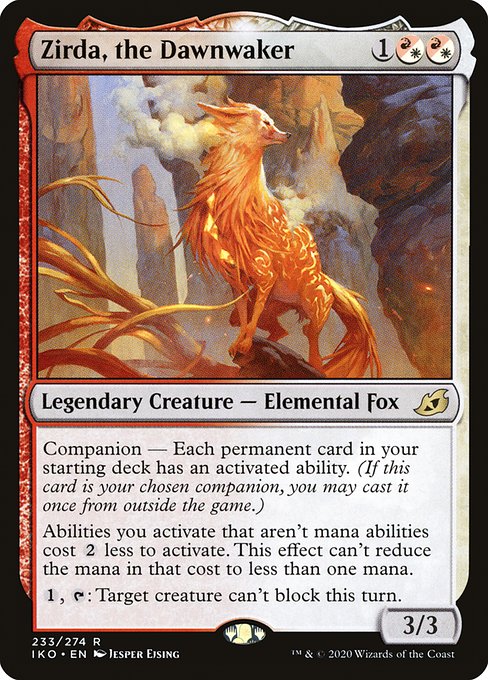
Zirda, the Dawnwaker strides into Ikoria: Lair of Behemoths as a rare legend with a wink and a wink—an unusual companion mechanic that invites deck builders to rethink how they assemble starting decks. Wrapped in red and white mana, this 3/3 fox-elemental arrives with a spicy utility that resonates with both casual players and the earnest collector. The card’s practical appeal—an activated-ability cost reduction (with a floor of one mana) and a dedicated combat trick—helps explain why Zirda remains a fixture in regional price conversations, even years after its release on 24 April 2020. 🧙♂️🔥
From a market perspective, Zirda sits at a crossroads. On average, non-foil copies hover around modest prices (the data snapshot shows around $0.45 USD), while foils carry a premium (roughly $0.93 USD). In Europe, the non-foil sits near €0.47 and the foil around €0.74. These numbers aren’t astronomical, but they reveal a consistent pattern: foil variants tend to carry a premium, and regional demand shapes the spread between currencies as distribution networks, shipping costs, and retailer markups tug prices in different directions. This is where regional price disparities really come alive—small currency gaps, import duties, and localized supply chains can widen or compress the difference between a card’s price in one country versus another. 💎⚔️
Mechanics that influence value and market chatter
- Companion lore and deck-building impact: Zirda’s companion rule—“Each permanent card in your starting deck has an activated ability”—encourages unusual, tightly themed decks. That kind of design nudges players to hunt specific card counts and activated-ability experiences, which can enhance demand for certain printings in regions where card pools are traditionally thinner. This dynamic helps explain why Zirda’s price might drift up in markets with a higher appetite for quirky, synergy-driven commanders. 🎨
- Ability cost mechanics: The ability that reduces activation costs by 2 (with a floor of one mana) makes Zirda an attractive anchor in budget or midrange builds. In practice, that drain-the-resources effect can swing games, and in parallel markets you’ll find players valuing cards that enable reliable, low-mana activations more highly, especially in Limited and casual Commander tables. 🧙♂️
- Rarity and print history: Issued in Ikoria: Lair of Behemoths, Zirda is a rare that hasn’t seen a reprint at the time of the card data snapshot. That absence of a recent reprint can buoy price floors in niche markets where players chase complete sets or foils. The current print run dynamics contribute to regional differences as distributors balance new stock against aging supply. 🔥
- Format accessibility: Legal in formats such as Historic, Modern (albeit with restrictions in some cases), Pioneer, Commander, and more, Zirda’s reach extends across player pools. Regional popularity can swing with Commander circles, where EDH/Commander skew drives demand for unusual synergies. A card with a solid EDHREC rank—around the mid-thirties to thousands depending on the exact year and booster cycle—often reflects a steady baseline interest that translates into price steadiness across locales. 🧭
Regional price disparities: what actually moves the needle
Several factors shape why Zirda’s price isn’t identical from Tokyo to Toronto to Tel Aviv:
- Local supply chains: The speed at which retailers can restock, especially for foil variants, directly affects sticker prices. Regions with robust online marketplaces and fewer middlemen tend to converge closer to the card’s base foil/non-foil differential. 🧭
- Currency and duties: Exchange rates, VAT, and import duties alter the final checkout price, sometimes widening the gap between USD-friendly markets and euro or pound-denominated regions. 💱
- Alternative outlets: Card stores, craft retailers, and importer storefronts all jockey for position. When a country’s market leans on card shops that bundle with accessories or lifestyle goods (think desk setups and gaming gear), you’ll often see slightly elevated prices that reflect cross-merchandising tactics. 🧰
- Collector incentives: Foil collectors chase different targets than casual players. If a region has a strong foil-centric community or a preference for alternate art, the foil price can outpace the non-foil by a notable margin, even for a card that isn’t a chase mythic. 🔍
Collectors, timing, and the impulse to “bag that foil”
Collector behavior often follows micro-cycles: a new commander deck release, a trending YouTube unboxing, or a price dip that invites budget-conscious players to upgrade with foils. Zirda’s appeal in this ecosystem is twofold. First, its design invites clever deck-building that many players want to showcase in casual and semi-competitive circles. Second, the card’s evergreen status in Commander drawers makes it a stable, if not spectacular, long-term hold for players who enjoy the thrill of a well-timed activation discount. The market responds with a steady stream of foil and non-foil copies circulating through global marketplaces like CardMarket and TCGPlayer, each adding a layer to the regional price tapestry. 🎲🧙♂️
When you spot a card like Zirda being discussed in regional forums, you’re seeing a microcosm of how collectors balance card condition, language, and storage. Foils often demand higher premiums in markets where sealed product is a scarce commodity, or where local shops emphasize high-value collectibles over single-card purchases. For this specific card, the given price snapshot suggests a relatively accessible entry point, with room to appreciate as supply tightens or as Zirda’s synergy becomes a more widely recognized archetype in Commander circles. ⚔️💎
What this means for you as a player and a collector
If you’re parsing the global price map for Zirda, the lesson is practical: don’t chase headlines—watch real-world supply and demand across your region. Look at foil vs. non-foil trends, scan local marketplaces for language-specific printings, and keep an eye on EDH/Commander chatter for shifts in popularity. And if you’re a desk setup aficionado who loves MTG as much as the game itself, a sturdy, responsive mouse pad can be a delightful companion for late-night deckbuilding—especially when you’re tracking board states, mana costs, and activated abilities with a steady, satisfying click. 🧙♂️🔥💎🎨🎲
For fans who want to blend practical play with a touch of MTG lifestyle, a quick detour into the shopping side can be rewarding. The product linked below isn’t just a desk accessory; it’s a reminder that every card purchase is part of a larger story—a story where regional markets, collector habits, and a little bit of luck at the prerelease table all contribute to the evolving mosaic of Magic pricing and value. And if you’re building a Zirda-centric deck, you’ll want a proper workspace to plan those big turns and cheeky plays. 🧙♂️